
FluffyWA

Positive training · Adult adoption first

Greyhound Training and Adult Adoption Manual

Puppy Stages Clearly Labelled

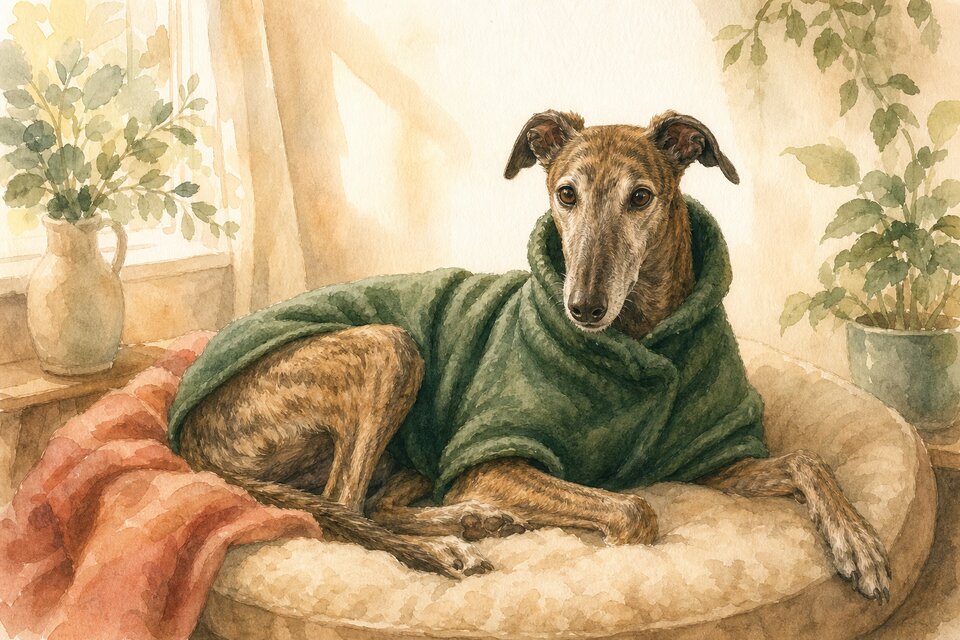
Adult Greyhound: warmth, soft bedding and low-pressure routines support comfortable settling.

29 chapters · English / 中文

Watercolour illustration of an adult brindle Greyhound wearing a dark green fleece coat while curled on a cushioned bed indoors
Adult Greyhound: warmth, soft bedding and low-pressure routines support comfortable settling.

Breed profile

Training group
Sighthounds
Origin
An ancient sighthound developed for visual pursuit; in Australia, many Greyhounds enter homes through retired racing-dog adoption.
Shoulder height
68–76 cm
Weight
25–40 kg
Coat
Extremely short coat with low body fat
Coat care
Build calm consent for gentle coat, body, paw and nail checks. Provide soft bedding and introduce any cold-weather clothing through voluntary, low-pressure handling.
Drive keywords
Visual lock-on · High-speed pursuit · Short-burst movement
Handling practice
Use gentle, low-pressure whole-body, coat, paw and nail handling: one brief touch, marker, reward and release before avoidance begins. · For a newly adopted adult, generalise handling separately across the actual home, vehicle and care settings; familiarity in one setting does not prove familiarity in another.

General reference range only; individual dogs vary considerably.

Teach clearly, manage first

Our training philosophy

LIMA means Least Intrusive, Minimally Aversive: use the least invasive, least unpleasant effective option.

Every technique in this manual stays within positive reinforcement and environmental management. We arrange the situation so the right behaviour is easy, then reinforce it so it becomes more likely.

The minimum learning theory you need

Antecedent

What happens immediately before the behaviour.

Behaviour

What the puppy actually does, described without labels.

Consequence

What follows; a reinforced behaviour becomes more frequent.

ABC example

Why talking to a jumping puppy can create more jumping

The puppy sees you arrive (A), jumps up (B), and you bend down and speak (C). If the puppy values your attention, that attention is reinforcement, so jumping increases. Change the consequence: keep attention unavailable while paws are up, then mark and give attention the moment all four paws are on the floor.

Management before training

At adult arrival, management solves most preventable problems first

Use gates, a quiet home base, marked glass and secure non-slip routes. Do not expect a newly adopted dog to understand an unfamiliar household before each feature has been introduced.

One learnable thing

Behaviour → cue → distraction

First make the behaviour reliable, then attach the cue, then add distraction. Reversing the order turns the cue into background noise.

Bribe

The food appears first and the puppy follows it before deciding what to do.

Reward

The behaviour happens first; the marker identifies it and the food follows as reinforcement.

Training with FluffyWA

Day school, board & train and private sessions are quoted after a chat, and boarding or daycare can be booked online with live prices.