
FluffyWA

Positive training · Adult adoption first

Greyhound Training and Adult Adoption Manual

Puppy Stages Clearly Labelled

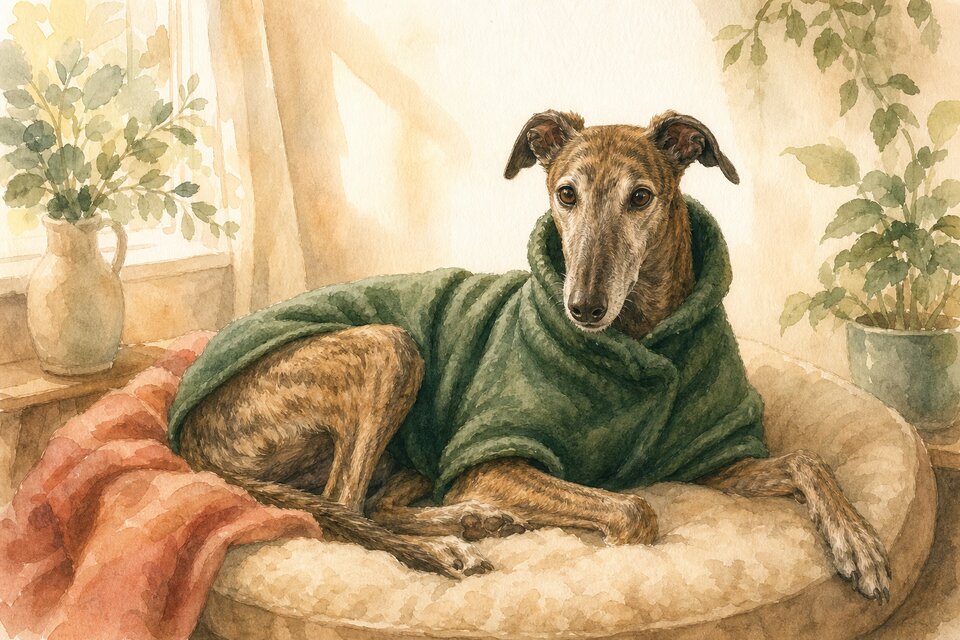
Adult Greyhound: warmth, soft bedding and low-pressure routines support comfortable settling.

29 chapters · English / 中文

Watercolour illustration of an adult brindle Greyhound wearing a dark green fleece coat while curled on a cushioned bed indoors
Adult Greyhound: warmth, soft bedding and low-pressure routines support comfortable settling.

Breed profile

Training group
Sighthounds
Origin
An ancient sighthound developed for visual pursuit; in Australia, many Greyhounds enter homes through retired racing-dog adoption.
Shoulder height
68–76 cm
Weight
25–40 kg
Coat
Extremely short coat with low body fat
Coat care
Build calm consent for gentle coat, body, paw and nail checks. Provide soft bedding and introduce any cold-weather clothing through voluntary, low-pressure handling.
Drive keywords
Visual lock-on · High-speed pursuit · Short-burst movement
Handling practice
Use gentle, low-pressure whole-body, coat, paw and nail handling: one brief touch, marker, reward and release before avoidance begins. · For a newly adopted adult, generalise handling separately across the actual home, vehicle and care settings; familiarity in one setting does not prove familiarity in another.

General reference range only; individual dogs vary considerably.

The cue that can save a life

Recall: the one that saves lives

Visual lock-on can send arousal to the top instantly and make recall difficult, with almost no warning before launch.
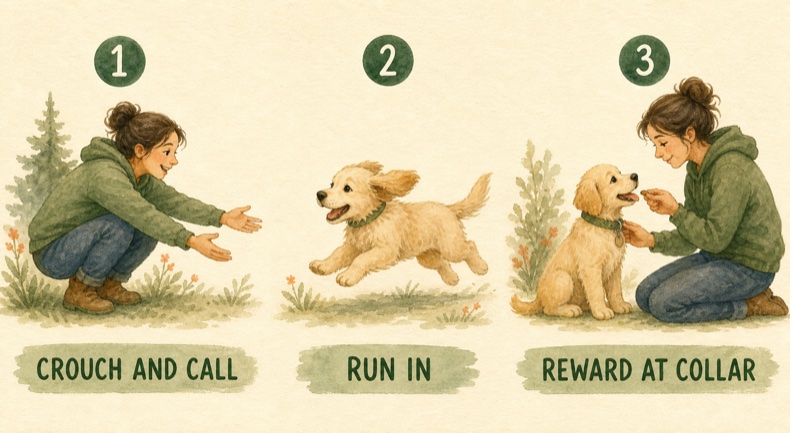
Watercolour diagram showing three dog recall steps
CROUCH AND CALL = invite once; RUN IN = the dog comes all the way to hand; REWARD AT COLLAR = touch the collar and reward.
  1. Stage 1 — quiet room

    Begin one or two steps away in a closed, quiet room. Say the cue once, move gently away, mark the turn and deliver the reward close to your body. Use a light house line if needed; never reel the dog in.

    Advance: Advance only after 3 consecutive days of 10 trials per day with at least 90% success.

  2. Stage 2 — secure private yard

    Audit gates, fence height, fence base and visual gaps first. Practise at short distance with no live-animal trigger present, using a safely handled long line if helpful. Reward early orientation; do not wait for fixation or sprinting to test the cue.

    Advance: Advance only after 3 consecutive days of 10 trials per day with at least 90% success.

  3. Stage 3 — booked secure fenced field

    Use an empty, securely fenced field after checking both gates. Start close, keep repetitions sparse and finish before scanning becomes fixation. The goal is reconnection within fencing, not proof that the dog can be released at a beach, oval, street or any unfenced place.

    Advance: Maintain this stage only after 3 consecutive days of 10 trials per day with at least 90% success.

Training with FluffyWA

Day school, board & train and private sessions are quoted after a chat, and boarding or daycare can be booked online with live prices.