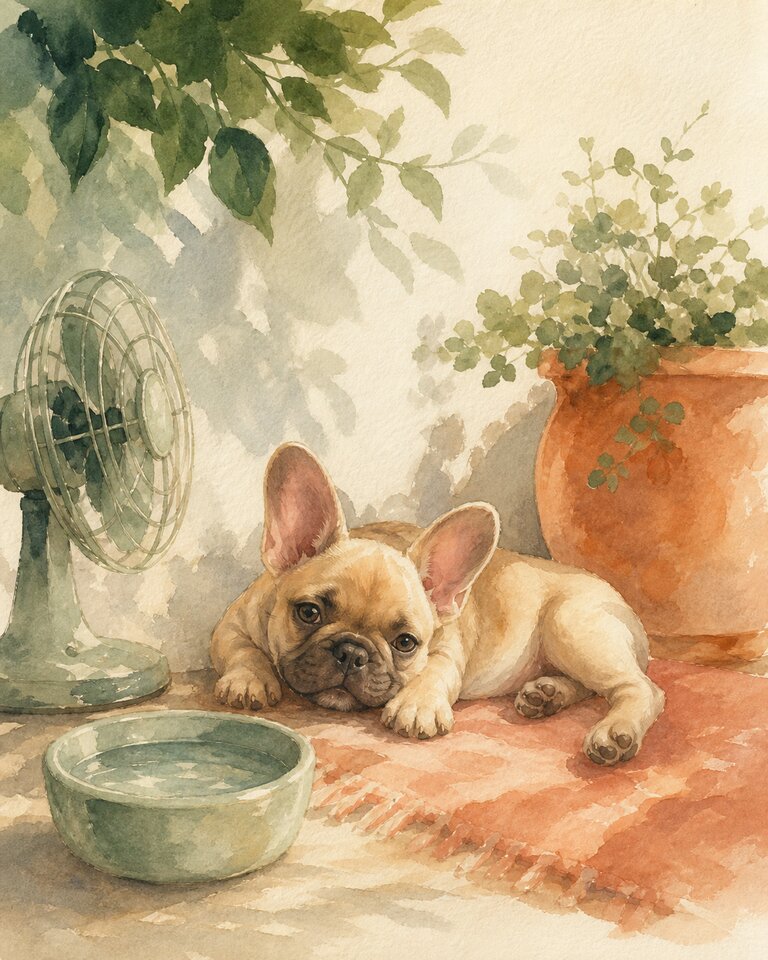
French Bulldog: choose shade, water and airflow before asking for training in warm weather.
29 chapters · English / 中文
French Bulldog: choose shade, water and airflow before asking for training in warm weather.
Breed profile
Training group
Brachycephalic dogs
Origin
Developed in England and France as a companion dog.
Shoulder height
27–35 cm
Weight
8–14 kg
Coat
Short coat
Coat care
Keep handling calm and gradual, with particular attention to comfortable touch around the mouth, nose and facial folds.
Drive keywords
Living closely with people · Play · Food
Handling practice
Condition touch around the mouth, nose and facial folds in tiny, voluntary steps: brief touch, marker, reward, then release before the puppy pulls away. · Teach bat-ear checks and nail care as two voluntary routines. For ears, show the hand, briefly lift the ear edge, mark, reward and release; never probe or force cleaning. For nails, build paw touch, one-second holds and tool presentation before attempting one nail. Sudden discomfort, redness or discharge needs veterinary advice.
General reference range only; individual dogs vary considerably.
27
Record patterns, not impressions
Training records & scorecards
Use these nine sheets in the browser or print blank copies for handwriting. They are working records, not a test of whether you are a “good” owner.
A short daily record makes patterns in training, toileting, sleep and recovery visible.
Browser entries are temporary and are not saved after a refresh; printed copies always show blank writing lines and empty boxes.
Sheet 01 · Training log
Fourteen sessions: record what happened and make the next step smaller and clearer
Date
Skill
Location
Duration
Success rate
Next step
Sheet 02 · One-week toilet record
Two starter lines per day; print another copy when you need more events
Day
Date
Time
Outdoor success
Indoor accident
Last meal
Day 1
Day 2
Day 3
Day 4
Day 5
Day 6
Day 7
Sheet 03 · Socialisation summary
Use Chapter 16 for the full 60-item checklist; this sheet records weekly progress and the experiences that need a gentler repeat.
Checklist rows are records, not owner-run live tests. If the breed profile requires professional assessment before exposure to cats or small animals, leave those rows untested and unscored, keep secure separation and record the management plan until the professional directs the next step.
Weekly totals and lower-intensity repeats
Week or dates
Items completed
Items to repeat
Lower-intensity plan
Sheet 04 · Sleep and arousal observation
One week: compare estimated sleep with over-arousal events
Date
Estimated total sleep
Over-arousal events
Trigger and recovery
Sheet 05 · Eight core cues in three locations
Tick only after one cue succeeds without visible food in that location
Cue
Living room
Backyard
New location
Sit
Down
Come
Wait
Leave it
Drop
Go to mat
Settle
Sheet 06 · Sixteen-week review
This review follows puppy development. For an adult rehome whose breed introduction restarts the clock after arrival, review behaviour records against the current after-arrival stage; leave puppy-only biological items blank and record them as not applicable alongside the review rather than forcing them onto the adult dog.
“Not yet” is a planning answer: return to the linked skill and lower the difficulty
Review item
Yes
Not yet
Predictable toilet rhythm with accidents becoming uncommon
Can rest calmly in the crate or pen for a protected nap
Can be alone for 30 minutes on video without sustained distress
Responds to the name once in moderate indoor distraction
Recall succeeds on an attached long line in a securely fenced backyard at least nine times out of ten
All eight core cues have a documented starting level
Can walk for two minutes on a loose lead near home
Socialisation checklist has been reviewed for gaps and difficult items
Daily routine includes independent enrichment and deliberate recovery
A plan exists for teething, adolescence, the second fear period and exercise limits
Sheet 07 · Weight & growth record
Twelve check-ins; for an adult rehome, write N/A under age and keep using date, weight and body-condition observation
Date
Age (weeks)
Weight
Body-condition observation
Sheet 08 · Vaccination & deworming record card
Vaccination record
Copy completed care and the next due date from the veterinary record
Vaccination / course entry
Date
Veterinarian / clinic
Next due
Deworming record
Record the product exactly as labelled; follow veterinary directions
Product as labelled
Date
Recorded weight
Sheet 09 · Weekly training log
One row per day; progress is a 1–5 planning score, not a judgement of the dog
Day / date
Skill this week
Practice minutes
Progress 1–5
Next-week focus
Training with FluffyWA
Day school, board & train and private sessions are quoted after a chat, and boarding or daycare can be booked online with live prices.