
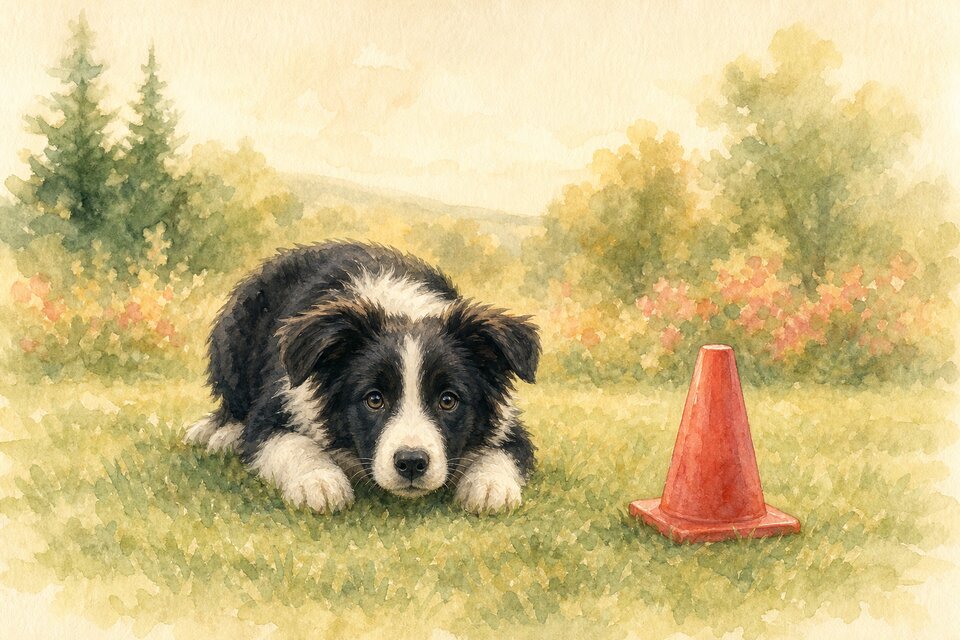
Movement can activate the strengthened chase sequence and compete with recall. Build reliability before raising movement or distance.
Recall is the easiest Border Collie skill to ruin. Once a puppy gives chase, the movement itself is rewarding, so protect the cue before testing it against the real world.
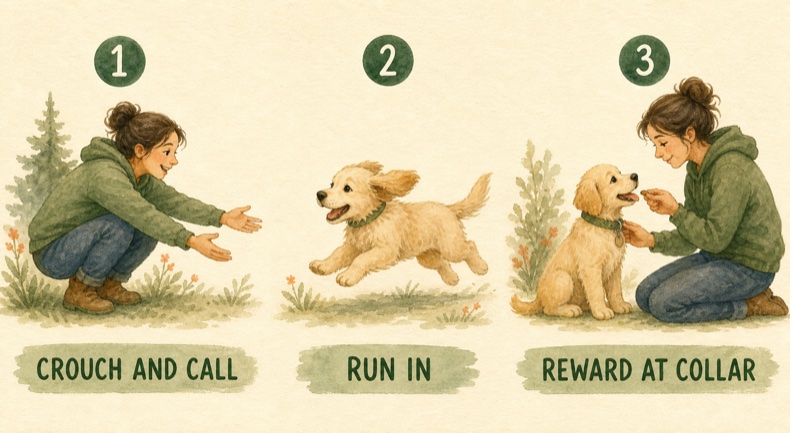
Build it from the house to the park
- Indoor follow-me game
Say the dog’s name once, move backwards a few gentle steps and reward a complete return to hand. Never chase the dog.
- Two-person ping-pong
Two people take turns calling and rewarding across a quiet room, one invitation at a time.
- Add the cue
When running to you is predictable, say “Come” once just before the puppy starts moving.
- Long line in the yard
Use a 5–10 m long line as a safety net. Begin with easy distance and very mild distractions.
- Long line in the park
Move to a quiet park only after the yard is reliable; increase distance or distraction, never both together.
- Group-specific long-line guidance
Use the long line around moving triggers and advance only after the puppy can disengage and respond reliably.
Emergency recall
Keep one cue behind glass
Choose a separate signal, such as two short whistle blasts. Practise it only once or twice a week and give a highest-value jackpot—served safely as several tiny pieces in succession and counted within the daily food allowance. Never spend the signal on an everyday recall.
Collar-touch conditioning
Arrival means coming all the way to hand
Recall, touch the collar gently, feed, then release. Repeating that sequence prevents the puppy from learning to orbit one metre beyond reach.