
If there is no red flag, carry out step X consistently for seven days while keeping a record. With no meaningful improvement, switch to Y for the next seven days. A red flag at any time means stop increasing the challenge and use Chapter 28—do not wait for the week to finish.
Path · Barking
Record the trigger, then teach a workable pause
- X · Days 1–7
Keep a three-day ABC record, block or increase distance from the predictable trigger, and reinforce a quiet turn-away or mat response.
- Y · No improvement after seven days
Use a lower-intensity setup for three two-minute practices daily. Audit whether attention, an opening door or the trigger leaving keeps the barking going; never shout back.
- Red flag
Extreme fear with poor recovery, or freezing, growling or lunging at someone approaching: stop and go to Chapter 28.
Path · Destruction
Prevent rehearsal and identify the unmet need
- X · Days 1–7
Remove dangerous objects, use gates or a pen, and first meet sleep, toileting and safe chewing needs.
- Y · No improvement after seven days
Review when and where it happens, turn one meal into sniffing or a food puzzle, and expand access only under direct supervision.
- Red flag
Suspected swallowed material, injury while damaging an exit, or sudden change: contact a veterinarian first and use Chapter 28.
Path · Jumping up
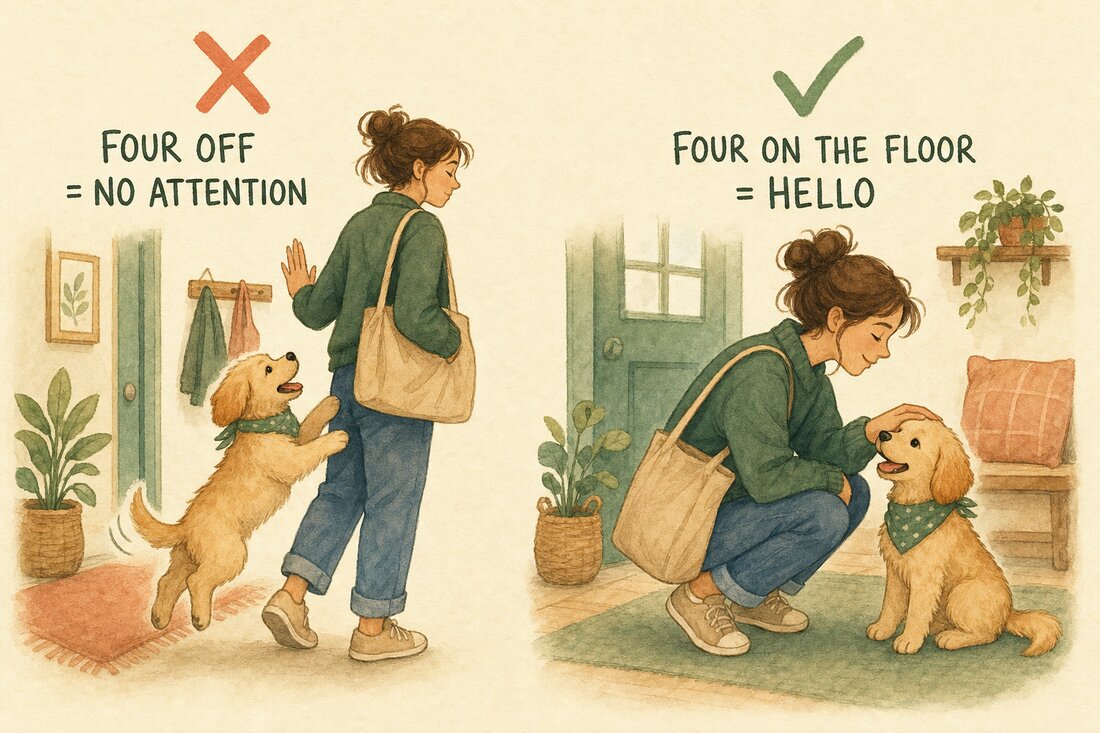
Make four paws on the floor open access
- X · Days 1–7
Use a short lead or gate to prevent contact. Mark and give attention as soon as all four paws are down; practise the mat before arrivals.
- Y · No improvement after seven days
Ask one calm helper to rehearse controlled entries: mat first, then greeting. Advance after eight of ten greetings keep four paws down.
- Red flag
Freezing, growling, a bite that marks, or strength that makes an older person or child unsafe: separate safely and use Chapter 28.
Path · Lead pulling and lunging
Distance first, loose-lead learning second
- X · Days 1–7
Increase distance immediately and use a turn-away or food scatter. Tight lead stops movement; a loose lead lets movement resume.
- Y · No improvement after seven days
Move to a quiet route, practise “see, then look back” for five minutes at a distance where food still works, and check the Y-shaped harness fit.
- Red flag
No recovery from the trigger, redirected biting towards the handler, or loss of safe physical control: stop exposure and use Chapter 28.
Path · Alone-time distress
Return before distress, then build seconds
- X · Days 1–7
Record a baseline, find the shortest absence without distress, begin with seconds and return calmly before the response changes.
- Y · No improvement after seven days
Shorten to the last successful duration, separate keys and shoes from real departures, and add a safe chew the puppy can complete independently.
- Red flag
Sustained severe distress, drooling, damage around exits or self-injury: do not let the puppy “cry it out”; go directly to Chapter 28.