
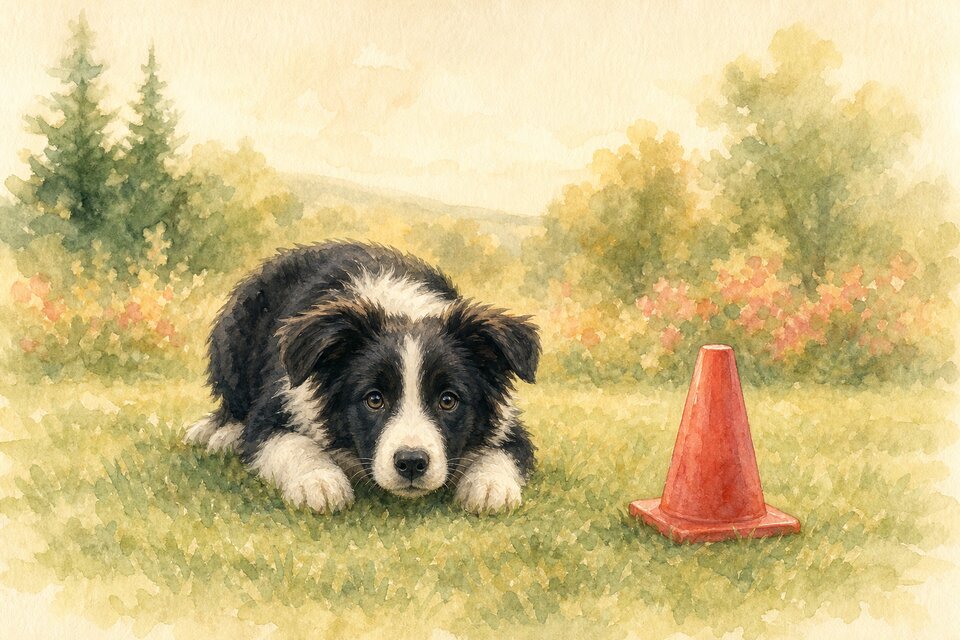
A Border Collie notices movement, patterns and tiny environmental changes very quickly. These six risks grow through repetition and self-reward, so prevention during puppyhood is far easier than undoing a rehearsed behaviour later.
Prevention card 01
Shadow and light chasing
Why it happens
Border Collies are at increased risk of compulsive patterns. A moving reflection or shadow can trigger orienting and chasing, then repetition makes the pattern increasingly absorbing.
Early signals
Freezing or stalking when light moves, scanning walls or floors, waiting beside a reflective surface, or struggling to disengage from a shadow.
Prevent it now
⚠️ Never use a laser pointer, and never tease with a torch. Control bright reflections, swinging curtains and moving light spots, then provide sniffing, chewing and food-search activities instead.
If it has started
Block the trigger, interrupt calmly without shouting, move to a different area and begin an easy sniffing search. Record the trigger, duration and recovery rather than repeatedly testing the puppy.
When to get professional help
Seek a veterinary behaviour specialist early if the puppy repeats this daily, cannot eat or respond during an episode, loses sleep, or continues searching after the light has gone; medical treatment may be needed.
Prevention card 02
Chasing cars, bicycles and runners
Why it happens
Fast real-world movement activates the orient–stalk–chase part of the predatory and herding sequence, and every successful chase rewards itself.
Early signals
A hard stare, lowered body, sudden weight shift, lunging as movement passes, fence running or ignoring food around traffic.
Prevent it now
Watch traffic from a distance where the puppy can still eat, mark the glance and reward the turn back to you using “Look at that.” Make street-facing fencing opaque and prevent unsupervised fence running.
If it has started
Prevent every further chase. Use a secure long line only in a safely set-back training area, use a short lead beside roads, increase distance and reward disengagement; do not rely on shouting.
When to get professional help
Get qualified reward-based help after any chase rehearsal or near miss, or whenever the puppy hits the end of the lead, cannot take food or cannot turn away at a safe distance.
Prevention card 03
Noise fear
Why it happens
Sudden, unpredictable sound can trigger a startle response, and overwhelming exposure can create a lasting fear association.
Early signals
Ears pinned back, a closed mouth, stopping eating, hiding, trembling, panting or scanning after a vacuum cleaner, thunder or distant bang.
Prevent it now
Pair recordings at barely audible volume with food and raise volume only while the puppy stays relaxed. Prepare a quiet safe room before Perth New Year’s Eve and Australia Day fireworks. Never use forced exposure or flooding.
If it has started
Stop or reduce the sound, increase distance, allow hiding and offer food only if the puppy chooses to eat. Do not restrain the puppy near the source to make it “get used to it.”
When to get professional help
Ask a veterinarian for a plan if there are escape attempts, self-injury, loss of toileting control, refusal of food or recovery that takes hours, especially before forecast storms or fireworks.
Prevention card 04
Resource guarding
Why it happens
A puppy may protect food, toys or space when an approaching person predicts loss. Grabbing items away teaches the puppy that people near valuables are a threat.
Early signals
Eating faster, carrying items away, hovering over an object, side-eye, a closed mouth, stiffening or freezing when someone approaches.
Prevent it now
Play the exchange game from Chapter 14, return safe objects after trading, and add better food when walking past the bowl. Never grab, reach into the bowl or “test” the puppy.
If it has started
Stop approaching or taking the item, use barriers to prevent unsafe access and do not punish a growl. A growl is a warning; punishing it removes the alarm, not the discomfort.
When to get professional help
Stop DIY handling and seek qualified help at the first freeze, growl, lifted lip, snap or bite, or whenever children share the home.
Prevention card 05
Herding children and visitors
Why it happens
Running feet, squeals and abrupt turns can activate eyeing, flanking and ankle nipping, while the person’s continued movement keeps the game rewarding.
Early signals
Staring at feet, crouching, circling, cutting off a person’s path, chasing trouser legs or becoming more intense when children run.
Prevent it now
Use gates and adult supervision whenever children may run. Teach a Go to mat routine for the door, ask visitors not to reach toward the puppy and provide a sniffing or chewing activity before arrivals.
If it has started
End the running setup, separate calmly, manage with a lead or barrier and reward the mat or another incompatible behaviour. Do not shout, chase or physically pin the puppy.
When to get professional help
Get professional help if the puppy cannot disengage, targets a child repeatedly, leaves bruising or broken skin, or the household cannot guarantee safe separation.
Prevention card 06
Over-attachment and separation anxiety
Why it happens
A puppy that is always accompanied has no chance to learn that brief separation is safe. A sudden long absence can then exceed its coping ability.
Early signals
Following every step, abandoning food behind a gate, reacting to keys or shoes, vocalising within seconds, panting, drooling or scratching at exits.
Prevent it now
Use the micro-absence plan in Chapter 11, keep exits and returns calm, and practise relaxing on a mat or with a safe chew while you move briefly out of sight.
If it has started
Use video to find the first stress signal, shorten absence below that threshold and arrange care for unavoidable longer periods. Do not use “cry it out” through escalating panic.
When to get professional help
Ask a veterinarian and a qualified reward-based professional for help if panic begins during very brief departures, or there is drooling, escape behaviour, toileting, destruction around exits or self-injury.