

Not every use of the mouth has the same cause. Identify the pattern first; then teach softer contact, fewer repetitions and a legal outlet for the herding sequence.
Three kinds of mouth behaviour
| Type | What it looks like | What it tells you |
|---|---|---|
| Exploratory mouthing | The puppy tests almost every object with its mouth. | Exploration needs safe objects and supervision. |
| Play mouthing | Mouthing appears with pouncing, bouncing and a loose body. | The puppy is playing and must learn to control force. |
| Herding nips | Low, fast nips target moving ankles, trouser legs or running children. | This comes from the grip stage of the herding behaviour chain. |
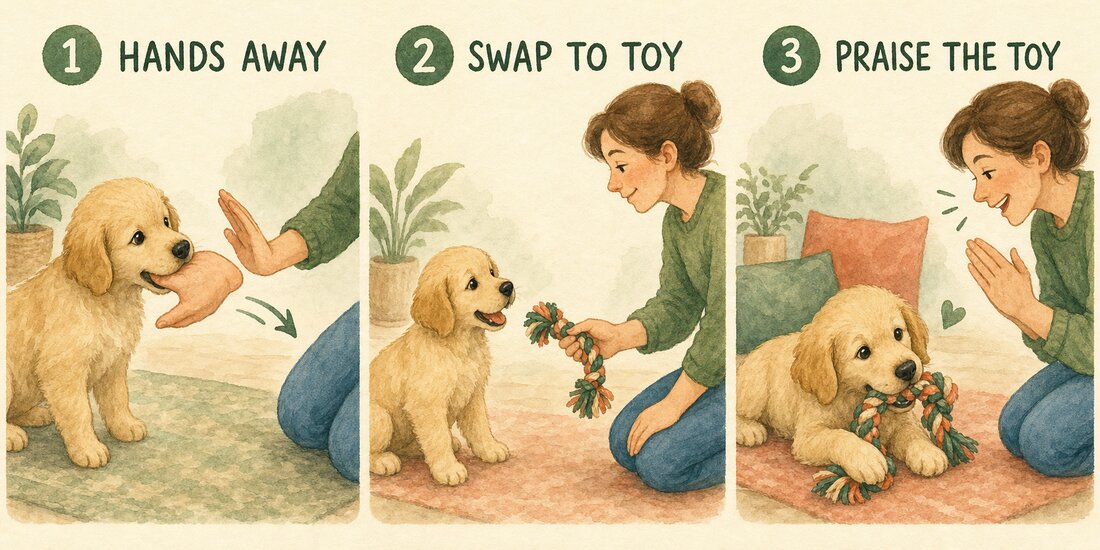
Teach bite inhibition in three stages
Do not demand “no mouthing at all” too early; that can skip the critical period in which the puppy learns to control force.
The four-part plan for herding nips
- Manage movement When children are running, keep the puppy on lead or behind a barrier. Do not expect self-control at 8–16 weeks.
- Provide a legal outlet Use tug toys and a flirt pole every day to complete a legal “chase + bite + win” cycle.
- Put rules around tug Begin on “Get it,” finish on “Drop” using Chapter 14’s exchange method, and end the game if teeth touch a hand.
- Give an alternative before the nip Before the puppy fixes on an ankle, cue “Go to mat” from Chapter 14 or scatter food so the mouth and eyes move to the ground.