
FluffyWA

Positive training · From eight weeks

Shiba Inu Puppy Training Manual

From 8 Weeks

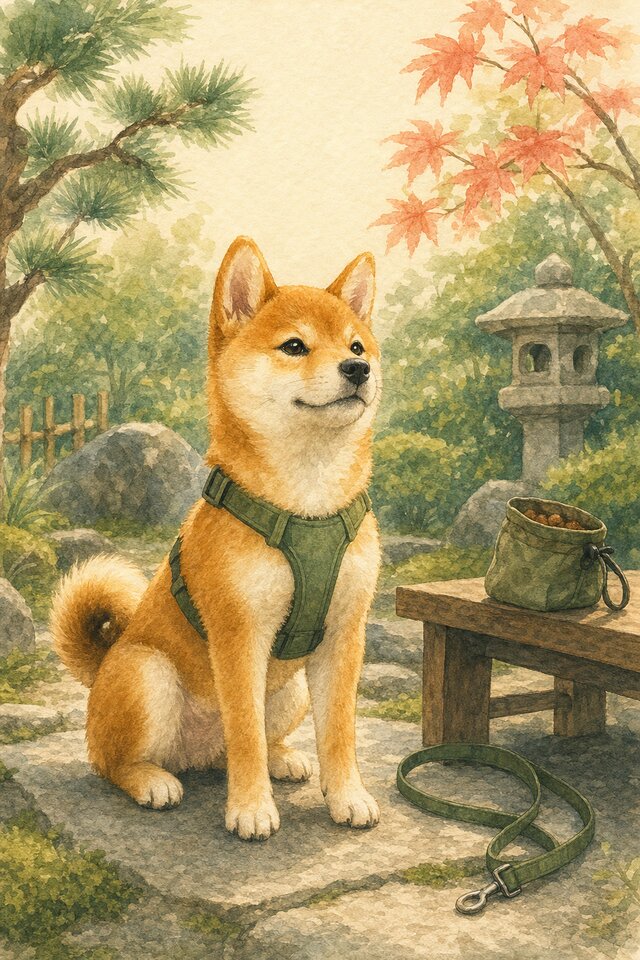
Harness, lead and reward pouch: build the Shiba Inu's voluntary cooperation alongside physical safety.

29 chapters · English / 中文

Watercolour illustration of a Shiba Inu puppy wearing a green harness beside a lead and reward pouch in a Japanese garden
Harness, lead and reward pouch: build the Shiba Inu's voluntary cooperation alongside physical safety.

Breed profile

Training group
Sled and spitz dogs
Origin
The Shiba Inu originated in Japan as a mountain hunting dog for birds and small animals.
Shoulder height
Approximately 35–41 cm
Weight
Approximately 7–11 kg
Coat
Harsh, straight outer coat with a soft, dense undercoat
Coat care
Seasonal coat shedding needs more frequent, short cooperative brushing sessions. Introduce coat separation, paw checks and dryer sound in tiny voluntary steps, pausing before vocal or avoidance behaviour escalates.
Drive keywords
Independent decision-making · Chase · Small-animal hunting · Environmental vigilance
Handling practice
During seasonal coat shedding, use frequent but very short sessions for brushing, coat separation and dryer sound, with a non-slip surface and a clear option to pause or leave. · During the 8–16 week window, arrange people with varied appearances, movement and voices at a distance where the puppy can eat, leave and recover. Do not require approach, touch or greeting.

General reference range only; individual dogs vary considerably.

Teach clearly, manage first

Our training philosophy

LIMA means Least Intrusive, Minimally Aversive: use the least invasive, least unpleasant effective option.

Every technique in this manual stays within positive reinforcement and environmental management. We arrange the situation so the right behaviour is easy, then reinforce it so it becomes more likely.

The minimum learning theory you need

Antecedent

What happens immediately before the behaviour.

Behaviour

What the puppy actually does, described without labels.

Consequence

What follows; a reinforced behaviour becomes more frequent.

ABC example

Why talking to a jumping puppy can create more jumping

The puppy sees you arrive (A), jumps up (B), and you bend down and speak (C). If the puppy values your attention, that attention is reinforcement, so jumping increases. Change the consequence: keep attention unavailable while paws are up, then mark and give attention the moment all four paws are on the floor.

Management before training

At eight weeks, management solves most preventable problems first

Use a playpen, baby gates, covered cables and a small supervised area. Do not expect a new puppy to resist an environment built for mistakes.

One learnable thing

Behaviour → cue → distraction

First make the behaviour reliable, then attach the cue, then add distraction. Reversing the order turns the cue into background noise.

Bribe

The food appears first and the puppy follows it before deciding what to do.

Reward

The behaviour happens first; the marker identifies it and the food follows as reinforcement.

Training with FluffyWA

Day school, board & train and private sessions are quoted after a chat, and boarding or daycare can be booked online with live prices.