
Teach the behaviour first, remove visible food, then add the word. Each card below uses the same four-part structure so the family can train and assess it consistently.
Breed priority
Recall on a secured long line or inside secure fencing
Breed priority
Door, latch and fence safety audit
Breed priority
Neutral stranger associations and cooperative handling
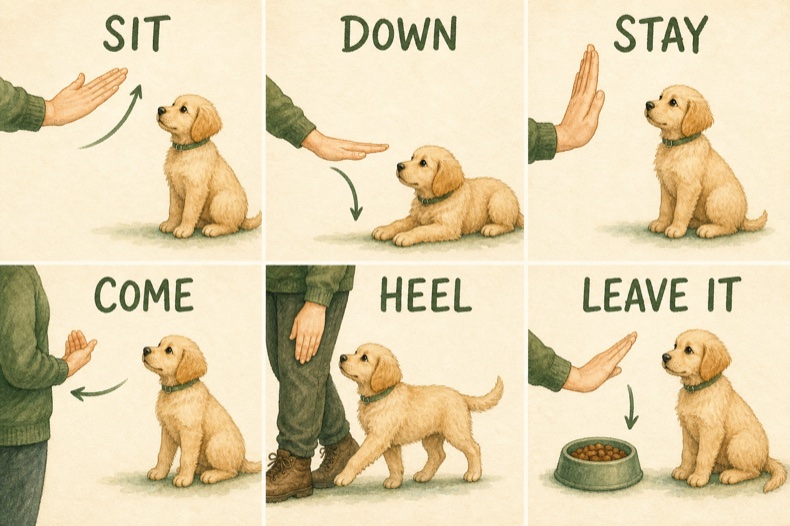
Cue 01
Sit
Purpose
The default behaviour for everyday waiting.
Teaching steps
- Lure the puppy’s nose slightly up and back until the rear touches the floor.
- Mark the instant the rear touches and deliver the reward at the mouth.
- Remove the food lure, repeat the same empty-hand signal, then add “Sit” just before the signal.
Common error
Repeating the word before the behaviour is reliable, or pushing the puppy’s rear down.
Pass standard
In a calm room, the puppy sits after one cue without visible food.
Cue 02
Down
Purpose
The foundation for remaining settled over longer periods.
Teaching steps
- Begin on a non-slip surface, from either a sit or a stand.
- Bring the lure to the floor between the forepaws, then slide it slowly forward along the ground.
- Mark when the elbows reach the floor and reward low between the paws.
- Repeat with an empty hand, then add “Down” just before the hand signal.
Common error
Training on a slippery floor or lifting the lure, which makes the puppy stand again.
Pass standard
On a non-slip surface, the puppy lies down after one cue without visible food.
Cue 03
Come
Purpose
The foundation of the life-saving recall developed fully in Chapter 17.
Teaching steps
- Say the puppy’s name once, then say “Come” once.
- Move backwards a few gentle steps so the dog follows; never chase the dog.
- Mark arrival and give a high-value reward.
- Touch the collar gently, reward, then release the puppy again.
Common error
Chasing the puppy, repeating the cue, or using “Come” only when fun is about to end.
Pass standard
In a calm room, the puppy comes to hand after one cue and accepts a collar touch.
Cue 04
Wait
Purpose
A life-saving cue that prevents rushing through doors, out of cars or into a food bowl.
Teaching steps
- Begin at a closed door, beside the car or before lowering the food bowl.
- Say “Wait” once and begin with one second.
- Mark before the puppy moves, then allow access to the door, car or bowl.
- Increase only one part of the challenge at a time.
Common error
Starting with an open doorway or a long duration before the one-second wait is reliable.
Pass standard
The puppy pauses for one second after one cue before a door, car exit or food bowl.
Cue 05
Leave it
Purpose
Teach the puppy that giving something up earns something better.
Teaching steps
- Close one hand around food and wait without pulling the hand away.
- When the puppy backs away, mark and reward from the other hand.
- Repeat with the closed food hand resting on the floor.
- Progress to food under an open hand, then uncovered food on the floor.
- Finally practise with a safe, real-life temptation on the ground.
Common error
Letting the puppy eventually eat the “leave it” item, or moving ahead while it is still pawing and biting at the hand.
Pass standard
With food visible on the floor, the puppy disengages after one cue and turns to the other hand for reinforcement.
Cue 06
Drop / Give
Purpose
Exchange objects safely without grabbing and creating resource guarding; see Chapter 26, Question 11.
Teaching steps
- Offer a safe toy and let the puppy hold it.
- Present high-value food at the nose and wait for the mouth to open.
- Mark the release and exchange the food for the object.
- Return the original object, then add “Drop” before the exchange once release is predictable.
Common error
Pulling the object away, prying the mouth open or never returning the safe item.
Pass standard
The puppy releases a safe object after one cue, accepts the exchange and receives the object back.
Cue 07
Go to mat / Place
Purpose
The manual’s most practical skill for doors, meals, visitors and lowering arousal in an over-excited puppy.
Teaching steps
- Shape the behaviour by marking any voluntary approach to the mat.
- Raise the criterion to one paw on the mat.
- Then mark only when all four paws are on the mat.
- Wait for a down on the mat and mark it.
- Build duration gradually, then add the verbal cue before the now-predictable movement.
Common error
Luring all the way onto the mat or adding duration and distractions at the same time.
Pass standard
In a calm room, the puppy goes to the mat, puts all four paws on and lies down after one cue.
Cue 08
Settle
Purpose
Reward a calm state—lying on the side and slower breathing—rather than a performed action.
Teaching steps
- Place the mat in the family activity area and sit nearby without asking for repeated cues.
- Spend 10 minutes doing nothing together each day.
- Quietly mark and reward side-lying, softened posture and slower breathing.
Common error
Turning settle practice into repeated Sit and Down cues, or delivering food so energetically that arousal rises again.
Pass standard
During the 10-minute family-area practice, the puppy lies on its side and its breathing visibly slows.
The 3D progression formula
How far the puppy or handler moves from the starting point.
How long the behaviour is maintained.
How much competing sound, movement or interest is present.
Increase only one D at a time. When one rises, lower the other two again.