
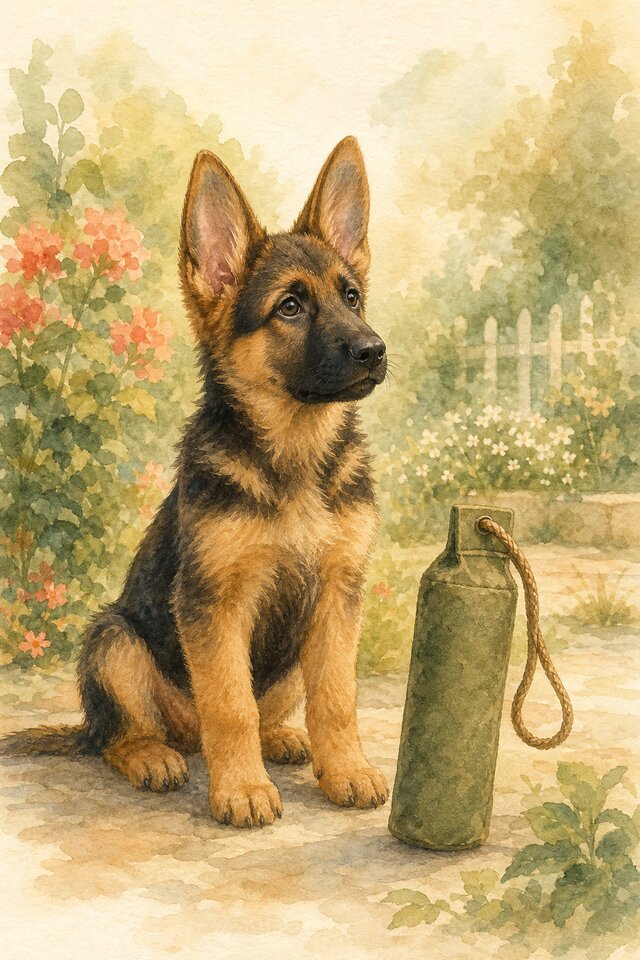
German Shepherd training risks grow when a developing puppy's strength and vigilance are repeatedly rewarded in the wrong setup. The answer is early skill-building, controlled exposure and environmental protection—not confrontation.
Prevention card 01
Adolescent alert barking at unfamiliar people
Why it happens
Guarding tendency can make unfamiliar people highly relevant as adolescence develops. If barking repeatedly creates distance, the behaviour can become the puppy's default strategy.
Early signals
The puppy scans entrances, closes its mouth, becomes still, shifts weight forward or away, stops taking food, or gives an alert bark as a person appears.
Prevent it now
Build varied, below-threshold exposure early. Let unfamiliar people remain neutral, reward observation and disengagement, and use distance or a barrier before the puppy needs to bark.
If it has started
Stop the approach, ask the person not to reach or stare, increase distance and reinforce the first calm turn back to the handler. Do not require a greeting to finish the exercise.
When to get professional help
Seek qualified behaviour help for persistent freezing, lunging, growling, snapping, biting or inability to recover; sudden behaviour change should be assessed by a veterinarian first.
Prevention card 02
Excess load on a growing large body
Why it happens
Large-breed growth-plate protection is stricter, while size and enthusiasm can make repeated stairs, jumps and forced exercise look easier than they are for a developing puppy.
Early signals
Furniture jumping or stair rushing becomes a routine route, the puppy slides on turns, movement quality changes, or the puppy becomes reluctant to move or be handled.
Prevent it now
Use barriers, stable non-slip level ground and self-paced low-impact activity. Keep repeated jumping and stair access unavailable and ask a veterinarian before adding impact.
If it has started
Block the repeated route immediately, move daily activities to level ground and stop adding exercise as a training solution. Do not train through discomfort.
When to get professional help
A sudden change in gait, reluctance to move, apparent pain or unusual handling sensitivity needs veterinary assessment rather than a training fix.
Prevention card 03
Grip and pulling become strength contests
Why it happens
Strong oral drive and increasing body mass make gripping and pulling highly effective when they keep play moving or deliver access to a destination.
Early signals
The puppy grabs the lead or clothing, braces into pressure, ignores Drop, reaches distractions on a tight lead or becomes harder to reorient as movement increases.
Prevent it now
Teach Drop and loose-leash walking in easy settings, keep toy games under predictable rules and stop forward access before pulling reaches the desired outcome.
If it has started
Stop moving without jerking back, reduce the distraction, use a clear trade for a gripped object and return to the last setup where one cue still worked.
When to get professional help
Get qualified reward-based help if pulling risks a fall or escape, gripping cannot be interrupted safely, or anyone is being injured.
Prevention card 04
Alone-time skill never develops
Why it happens
A puppy selected for close cooperation can spend most of the day beside people. Constant company prevents rehearsal of safe, gradual separation rather than proving the puppy is comfortable alone.
Early signals
The puppy shadows every movement, cannot settle behind a barrier, reacts to departure preparations or shows rising distress as soon as the person disappears.
Prevent it now
Practise very easy separation while needs are met, record the puppy, return before distress rises and vary departure signals gradually rather than stacking them together.
If it has started
Stop testing longer absences, return to the last separation step that remained settled and rebuild from recorded evidence rather than leaving the puppy to escalate.
When to get professional help
Seek veterinary and qualified behaviour support if distress is intense, begins immediately, includes escape attempts or self-injury, or does not improve with careful below-threshold practice.