
FluffyWA

Positive training · From eight weeks

Pembroke Welsh Corgi Puppy Training Manual

From 8 Weeks

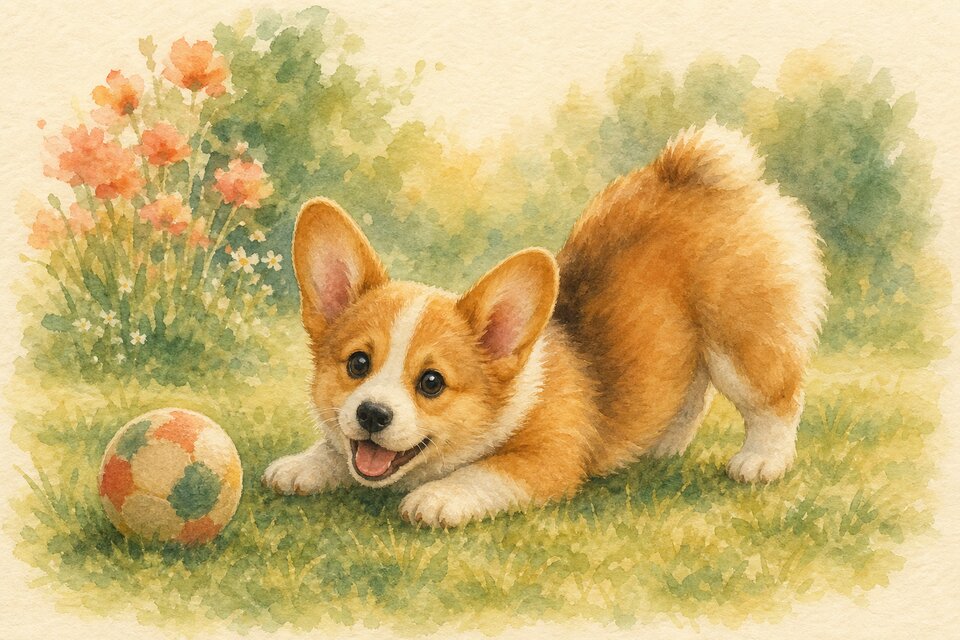
A play bow toward a colourful ball: give the Pembroke Welsh Corgi's movement-control instincts safe, low-impact outlets.

29 chapters · English / 中文

Watercolour illustration of a Pembroke Welsh Corgi puppy play-bowing toward a colourful ball on grass
A play bow toward a colourful ball: give the Pembroke Welsh Corgi's movement-control instincts safe, low-impact outlets.

Breed profile

Training group
Herding and cattle dogs
Origin
The Pembroke Welsh Corgi originated in Wales as a low-set cattle-herding dog, moving stock in part by working at their heels.
Shoulder height
Approximately 25–30 cm
Weight
Males approximately 10–12 kg; females approximately 9–11 kg
Coat
Medium-length double coat
Coat care
Build voluntary acceptance of brushing, coat checks, airflow and dryer noise. Increase brief, comfortable brushing during seasonal shedding rather than forcing a long session.
Drive keywords
Controlling movement · Heel gripping · Cooperation with people · Food motivation
Handling practice
Condition double-coat brushing, line-by-line coat checks, airflow and dryer noise in brief voluntary steps, increasing frequency during seasonal shedding without increasing force. · Teach calm ramp use and cooperative lifting with one arm supporting the chest and the other supporting the hindquarters; do not let the body dangle.

General reference ranges only; individual dogs vary considerably.

The cue that can save a life

Recall: the one that saves lives

Movement can activate the strengthened chase sequence and compete with recall. Build reliability before raising movement or distance.
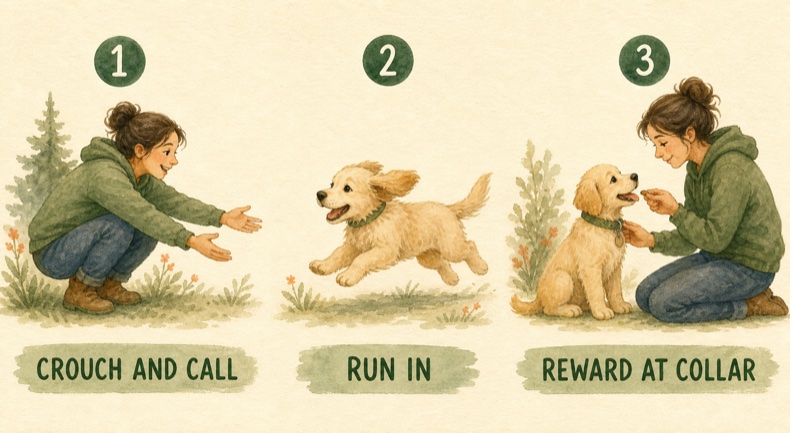
Watercolour diagram showing three dog recall steps
CROUCH AND CALL = invite once; RUN IN = the dog comes all the way to hand; REWARD AT COLLAR = touch the collar and reward.

Build it from the house to the park

  1. Indoor follow-me game

    Say the dog’s name once, move backwards a few gentle steps and reward a complete return to hand. Never chase the dog.

  2. Two-person ping-pong

    Two people take turns calling and rewarding across a quiet room, one invitation at a time.

  3. Add the cue

    When running to you is predictable, say “Come” once just before the puppy starts moving.

  4. Long line in the yard

    Use a 5–10 m long line as a safety net. Begin with easy distance and very mild distractions.

  5. Long line in the park

    Move to a quiet park only after the yard is reliable; increase distance or distraction, never both together.

  6. Group-specific long-line guidance

    Use the long line around moving triggers and advance only after the puppy can disengage and respond reliably.

Emergency recall

Keep one cue behind glass

Choose a separate signal, such as two short whistle blasts. Practise it only once or twice a week and give a highest-value jackpot—served safely as several tiny pieces in succession and counted within the daily food allowance. Never spend the signal on an everyday recall.

Collar-touch conditioning

Arrival means coming all the way to hand

Recall, touch the collar gently, feed, then release. Repeating that sequence prevents the puppy from learning to orbit one metre beyond reach.

Training with FluffyWA

Day school, board & train and private sessions are quoted after a chat, and boarding or daycare can be booked online with live prices.