

Sexual maturity is not social maturity. An adolescent may look nearly grown while attention, impulse control and recovery are still under construction.
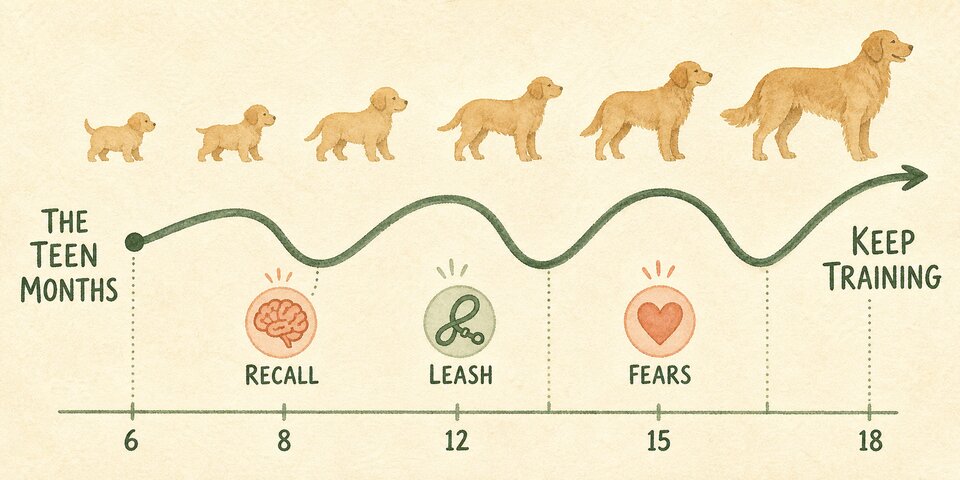
The so-called “selective hearing” phase reflects development and stronger competition from the environment. It is not rebellion, dominance or evidence that you need so-called “alpha” methods. Small dogs may enter earlier; larger dogs may begin later and mature more slowly. Use age ranges for planning, then train the dog in front of you.
Six regressions: rebuild, do not punish
Regression 01 · Recall
The environment wins again
Why: Novel scent, movement and social interest now carry more value.
Rebuild: Reattach the long line, halve distance and distraction, pay every complete return and release often.
Red flag: Repeated escapes or chase lock-on means management first and Chapter 28 help.
Regression 02 · Lead
Pulling and lunging return
Why: A stronger body reaches rewards faster while self-control remains immature.
Rebuild: Choose a quiet route, shorten the session, reward check-ins and use distance before practising around triggers.
Red flag: If the handler loses safe control or redirected biting appears, stop exposure and use Chapter 28.
Regression 03 · Second fear period
One fright can become a lasting lesson
Why: Development can temporarily change how familiar people, places or objects are assessed.
Rebuild: Increase distance immediately, pair the sight with high-value food, preserve an exit and never force approach or punish fear.
Red flag: Fear that generalises, prevents recovery or brings freezing, growling or lunging needs qualified help.
Regression 04 · Dog tolerance
Social preference may narrow
Why: Maturity can make indiscriminate puppy play less appealing; this is individual information, not a breed label.
Rebuild: Choose compatible partners, protect rest, use parallel walks and end before stiffness or avoidance escalates.
Red flag: A bite, repeated pinning, poor recovery or a sudden change requires separation and professional assessment.
Regression 05 · Marking and roaming
Hormones change priorities, not household safety
Why: An intact adolescent male may mark or seek scent trails; an adolescent female's cycle can also change attention and management needs.
Rebuild: Supervise indoors, clean without punishment, audit doors and fences, and use a secured lead outdoors.
Red flag: Escape attempts, sudden urinary change or distress needs prompt management and appropriate veterinary advice.
Regression 06 · Toileting
An accident is data, not defiance
Why: Changed routines, distraction, scent marking or too much freedom can weaken a previously reliable pattern.
Rebuild: Restore the earlier outing frequency, supervise, reward outdoors and record time, context and last meal.
Red flag: A sudden persistent change, discomfort or unusual drinking should be discussed with a veterinarian.
Hormones, growth and the veterinarian conversation
Growth plates may not close until twelve to eighteen months, with timing varying by body size and individual development. Keep Chapter 20's impact limits until veterinary review. This manual gives no desexing-age recommendation. Instead, take questions: What does this dog's growth and health history suggest? Which behaviour changes are relevant? What recovery and activity restrictions would follow? How should household management change before and after the procedure?
Printable preparation and month-by-month plan
Month five is a preparation row before the six-to-eighteen-month adolescence window; it is not an earlier fixed start date.
| Month | Main focus | Skill maintenance | Socialisation maintenance | Enrichment | Self-check |
|---|---|---|---|---|---|
| Preparation · 5 months | Teething plan. | Marker, name and trade. | One easy novelty. | Chew and sniff. | Sleep; mouth-pressure recovery. |
| 6 months | Recall safety. | Ten long-line returns. | Calm distance viewing. | Scatter-search meals. | Gates; response rate. |
| 7 months | Loose lead near movement. | Mat after outings. | Calm parallel walks. | Short scent trails. | Eating distance holds. |
| 8 months | Second fear response. | Easy known cues. | Choice, distance, exits. | Familiar puzzles. | Trigger and recovery log. |
| 9 months | Compatible dog choices. | Recall, then release. | Selected parallel walks. | Tug with stop cue. | End before stiffness. |
| 10 months | Settle after outlets. | Doorway waits. | Calm public observation. | Group-outlet rotation. | Breathing and sleep. |
| 11 months | Generalise one cue. | Three easy places. | One novel surface. | Box search. | Lower criteria each place. |
| 12 months | Veterinary growth review. | Recall and lead refresh. | Brief neutral visits. | Low-impact problem-solving. | No automatic clearance. |
| 13 months | Recall physical safety. | Reward collar touch. | Wildlife at distance. | Secured scent trail. | No chase tests. |
| 14 months | Alone time after change. | Seconds below threshold. | Arrivals with mat. | Independent chew. | Video before distress. |
| 15 months | Cooperative handling. | Chin rest and paw consent. | Happy clinic visit. | Choice-based handling. | Pause when the dog withdraws. |
| 16 months | Enrichment balance. | One cue per outlet. | Selected dog contact. | Rotate four activity types. | Settle after each. |
| 17 months | Calm public routines. | Settle and check-ins. | One easy public place. | Sniff decompression. | Leave while recovering. |
| 18 months | Evidence audit. | Retest core skills. | Keep compatible contacts. | Keep the best rotation. | Protect individual management. |