
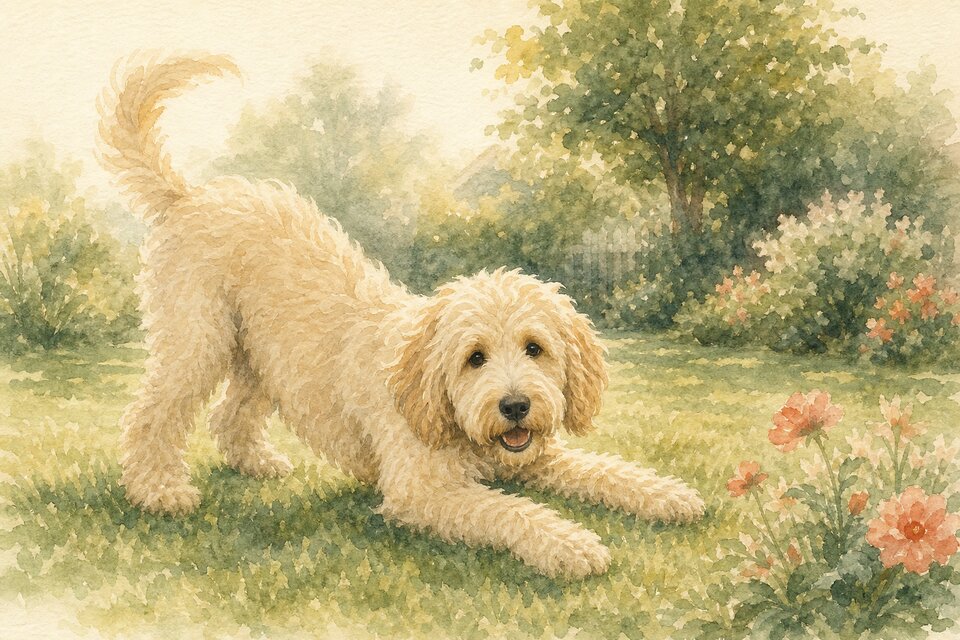
The most useful prevention rule is to replace assumptions about the cross with observation, then manage coat care, mouthing, growth and social exposure around the individual puppy.
Prevention card 01
Training an imagined parent-breed average
Why it happens
Crossbred behaviour is not an average, and individual variation is greater. A plan based only on one parent label can miss the drive that is actually controlling behaviour.
Early signals
The chosen reward repeatedly fails, retrieving drills lose the puppy, or mouthing, carrying and problem-solving appear in contexts the family did not prepare for.
Prevent it now
Record triggers, preferred rewards and recovery after each type of task. Keep both retriever and Poodle plans available and use the one supported by the puppy’s observable response.
If it has started
Stop repeating the mismatched task, lower the difficulty and test one clear alternative reinforcement channel without changing several variables at once.
When to get professional help
Seek qualified positive-reinforcement help if the family cannot identify workable rewards or the puppy persistently freezes, avoids, growls or snaps during training.
Prevention card 02
Grooming avoidance and matting
Why it happens
The substantial curly or wavy coat can mat and needs regular clipping. Forced care makes avoidance stronger and leaves future grooming harder.
Early signals
The puppy leaves when tools appear, turns from the brush, grabs at hands, cannot stand calmly or reacts to dryer or clipper sounds.
Prevent it now
Practise one easy voluntary grooming element at a time, pair it with reinforcement and release, and keep coat care from becoming urgent through neglect.
If it has started
Stop restraint, return to a tool or body area the puppy can accept and rebuild in smaller steps; do not pull through tangles while the puppy struggles.
When to get professional help
Use a qualified cooperative groomer or reward-based trainer when routine care cannot be completed without sustained distress; sudden sensitivity also needs veterinary assessment.
Prevention card 03
Unsafe mouthing and object pickup
Why it happens
Retriever-style mouth use may appear strongly, and access to household objects can turn normal exploration into an ingestion risk.
Early signals
Scanning floors, repeatedly stealing laundry or rubbish, moving away when approached, swallowing faster when a person reaches in, or refusing familiar trades.
Prevent it now
Clear the environment, provide safe carrying and chewing objects, teach Leave it and Drop through worthwhile trades, and often return safe items after release.
If it has started
Do not chase or force the mouth. Secure access, trade at a workable distance and contact a veterinarian immediately if ingestion is known or suspected.
When to get professional help
Get veterinary help for known or suspected ingestion, and qualified behaviour help if the puppy freezes, growls, snaps or repeatedly swallows to prevent removal.
Prevention card 04
Equipment and exercise no longer fit growth
Why it happens
Adult size is uncertain across a miniature-to-standard, 10–35 kg range. A setup based on prediction can become unsuitable as the individual develops.
Early signals
Harness fit changes, the resting or training space becomes awkward, movement quality changes, or the puppy struggles to recover from the current activity pattern.
Prevent it now
Reassess fit and movement against the dog’s current body, keep activity low-impact and self-paced, and apply the manual’s general growth-plate protections.
If it has started
Stop using the mismatched setup, replace or adjust equipment for the current body and lower activity while the plan is reviewed.
When to get professional help
A sudden movement change, reluctance to move or apparent pain needs veterinary assessment rather than an exercise adjustment alone.
Prevention card 05
Social excitement replaces socialisation
Why it happens
Gundog social excitement can make people or dogs more valuable than the handler, while the cross label still cannot predict this individual’s response.
Early signals
Pulling directly towards every person or dog, jumping, ignoring food or cues, or needing increasingly close contact to remain engaged.
Prevent it now
Use selected exposures at a distance where the puppy can observe, disengage and respond; reinforce four paws on the ground and calm orientation back to the handler.
If it has started
Increase distance, stop automatic greetings and resume only where the puppy can eat, orient back and leave with the handler.
When to get professional help
Seek qualified help if social exposure repeatedly produces sustained fear, lunging, growling, snapping or an inability to recover after distance is added.