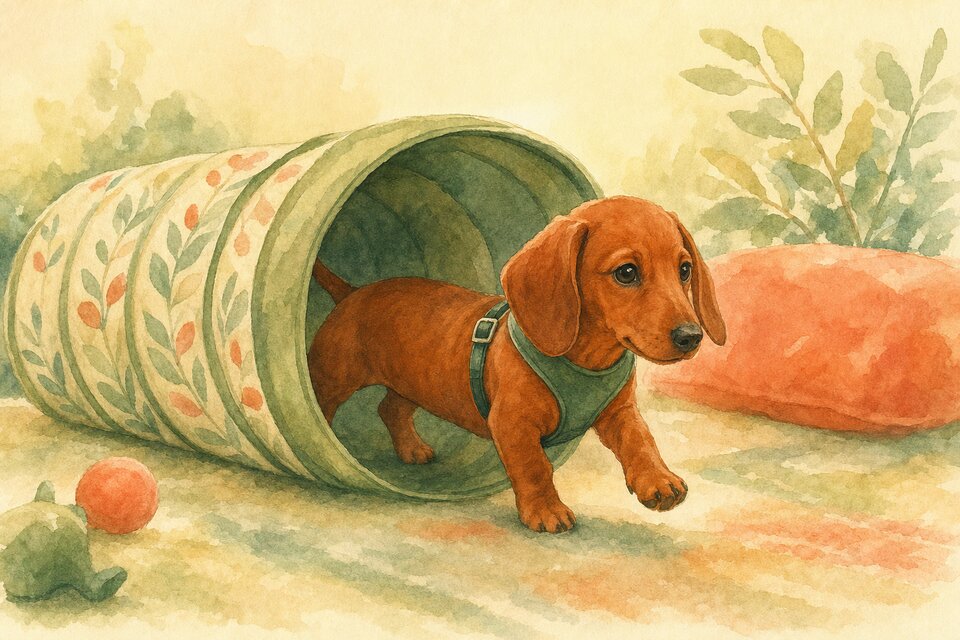
Dachshund: a well-fitted Y-front harness and low tunnel support safe, low-impact confidence work.
29 chapters · English / 中文
Dachshund: a well-fitted Y-front harness and low tunnel support safe, low-impact confidence work.
Breed profile
Training group
Scenthounds
Origin
The Dachshund originated in Germany as an earth-working hunting dog.
Standard weight
7–15 kg
Miniature weight
4–5 kg
Shoulder height
13–23 cm
Coat
Short, long or wire coat
Coat care
Choose grooming tools for the individual coat and condition brushing, body checks and paw handling gradually. Make calm, supported lifting and ramp use voluntary learned skills rather than sudden restraint.
Drive keywords
Scent · Digging · Den guarding
Handling practice
Condition both supported lifting and Y-front-harness wear in tiny voluntary steps: cue, hands or harness presented, brief supported lift or one strap movement, marker, reward and return to stable ground before struggle. Choose a harness that leaves the shoulders free, avoids neck loading and is rechecked as the puppy grows. · Match brushing and body checks to the individual short, long or wire coat, with calm paw and under-body handling rather than forced restraint.
General reference ranges only; individual dogs vary considerably.
05
Development has a clock
The 8–16 week window
Between eight and sixteen weeks, the puppy is learning what is safe, ordinary and worth avoiding.
You cannot pause this developmental period. The goal is not maximum exposure; it is carefully controlled experience at an intensity the puppy can process.
Development timeline
0–3 weeksNeonatal period
Basic sensory and physical development.
3–8 weeksDog-to-dog socialisation
Early dog-to-dog learning begins with littermates and stable adult dogs and continues after the puppy goes home.
8–16 weeksHuman and environmental socialisation sensitive period
Build calm, positive or neutral associations with ordinary life.
About 8–11 weeksFirst fear period
One intense fright can create a durable fear memory.
4–6 monthsTeething
Chewing needs increase as adult teeth replace puppy teeth.
6–12 monthsAdolescence
Expect a second fear period and a temporary “selective hearing” phase.
Sleep requirement
18–20 hours every day at eight weeks
Sleep loss often intensifies frantic biting, zooming and difficulty settling. Use scheduled, protected naps; see Chapters 7 and 19.
Attention span
2–3 minutes, 4–6 times a day
Several tiny successful sessions teach more than one exhausted 30-minute session.
Training with FluffyWA
Day school, board & train and private sessions are quoted after a chat, and boarding or daycare can be booked online with live prices.