
FluffyWA

Positive training · From eight weeks

Dachshund Puppy Training Manual

From 8 Weeks

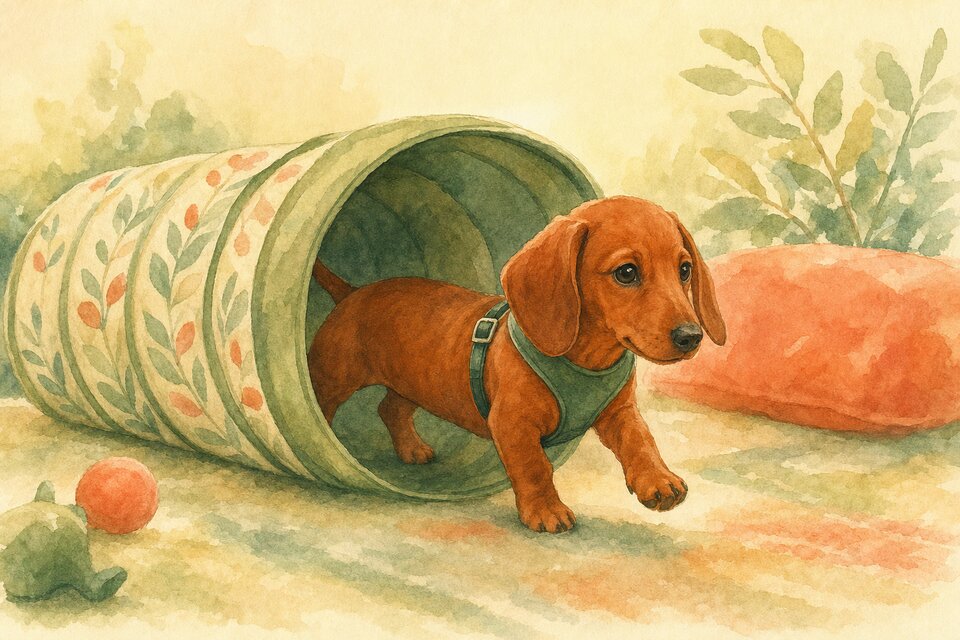
Dachshund: a well-fitted Y-front harness and low tunnel support safe, low-impact confidence work.

29 chapters · English / 中文

Watercolour illustration of a Dachshund puppy wearing a green Y-front harness while walking out of a fabric training tunnel
Dachshund: a well-fitted Y-front harness and low tunnel support safe, low-impact confidence work.

Breed profile

Training group
Scenthounds
Origin
The Dachshund originated in Germany as an earth-working hunting dog.
Standard weight
7–15 kg
Miniature weight
4–5 kg
Shoulder height
13–23 cm
Coat
Short, long or wire coat
Coat care
Choose grooming tools for the individual coat and condition brushing, body checks and paw handling gradually. Make calm, supported lifting and ramp use voluntary learned skills rather than sudden restraint.
Drive keywords
Scent · Digging · Den guarding
Handling practice
Condition both supported lifting and Y-front-harness wear in tiny voluntary steps: cue, hands or harness presented, brief supported lift or one strap movement, marker, reward and return to stable ground before struggle. Choose a harness that leaves the shoulders free, avoids neck loading and is rechecked as the puppy grows. · Match brushing and body checks to the individual short, long or wire coat, with calm paw and under-body handling rather than forced restraint.

General reference ranges only; individual dogs vary considerably.

Teach safe mouth skills

Mouthing, digging & resource exchange

Exploratory mouthing, digging with the mouth and paws, and guarding a den or found item are different patterns. Teach bite inhibition, provide a legal digging outlet and use voluntary exchange instead of reaching in or grabbing.
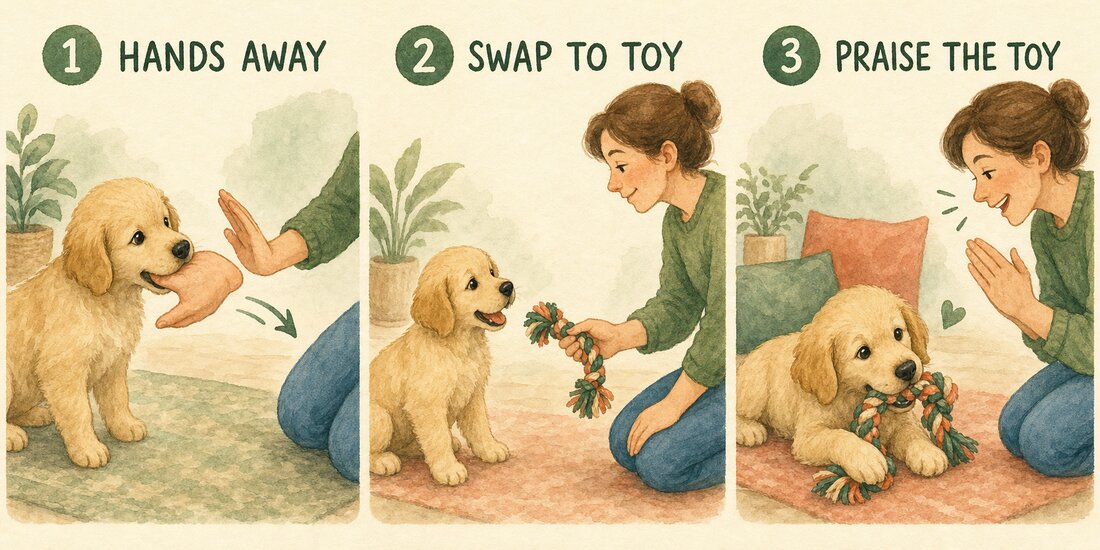
Watercolour three-step diagram showing hands moving away and puppy mouthing redirected to a toy
HANDS AWAY = make hands still and unavailable; SWAP TO TOY = offer an appropriate toy; PRAISE THE TOY = reinforce chewing the toy.

Identify the pattern before responding

Teach the mouth, redirect the digging and trade the resource
PatternWhat it looks likeWhat it needs
Exploratory mouthingA loose puppy samples hands, clothing or safe objects with the mouth.Teach bite-force control and redirect to an appropriate object.
Digging outletThe puppy follows scent, paws and noses into suitable loose material in a designated area.Reinforce this legal location while blocking unsafe edges, gardens and escape routes.
Resource or den guardingThe body stills, the puppy hovers over an item or stays deep in the den as a person approaches.Stop approaching, create space and use a trained trade or voluntary exit at an easier level.

Teach bite inhibition in three stages

8–12 weeks First: reduce force After a painful bite, give one brief “Ouch” and stop interaction for 3–5 seconds; resume only when the puppy is settled.
12–16 weeks Then: reduce frequency Reinforce play that stays on safe toys and interrupt repeated contact with skin or clothing before arousal rises.
After 16 weeks Finally: keep teeth off people Keep mouth play on safe objects and retain the same calm start-and-stop rules.

Do not skip force control by demanding zero mouthing immediately. Guarding needs space and exchange, not a stronger physical response.

A voluntary exchange routine

  1. Begin with low-value safe items Approach only to a comfortable distance, present a worthwhile reward and mark the puppy choosing to release or move away.
  2. Return safe items sometimes Secure unsafe items, but return safe practice objects often enough that a person approaching does not always predict loss.
  3. Cue the voluntary den exit Call from outside the resting area, reward on stable ground away from the entrance and leave the den undisturbed when no exit is needed.

Training with FluffyWA

Day school, board & train and private sessions are quoted after a chat, and boarding or daycare can be booked online with live prices.