
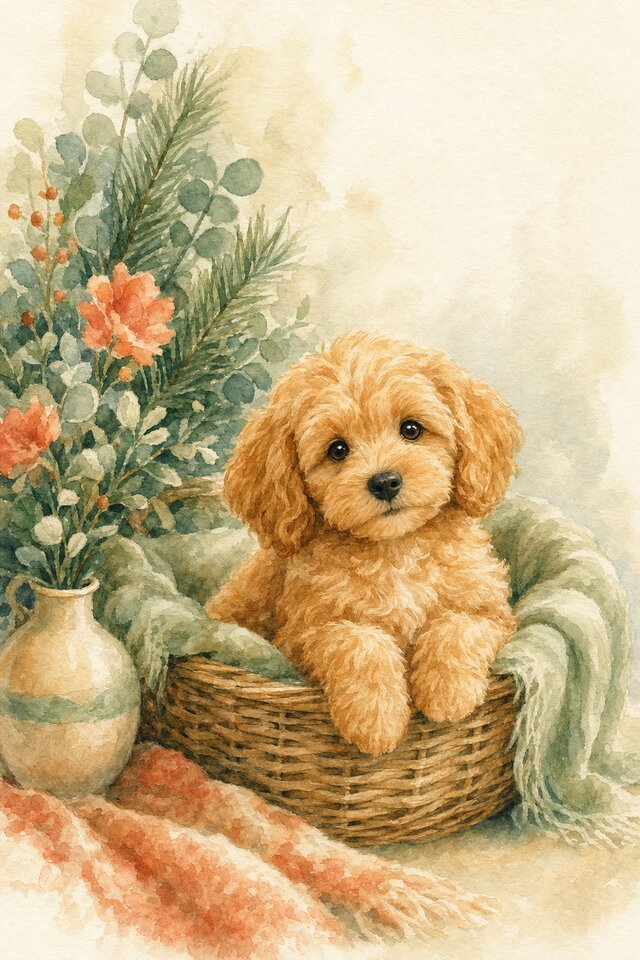
The Cavoodle is a Cavalier King Charles Spaniel × Poodle cross and one of Australia's most common crossbreeds. Its behaviour is not the midpoint between two breeds: individual variation is greater, and the training plan must be ready for companion-type attachment as well as Poodle-side problem-solving or retrieving where those drives actually appear.
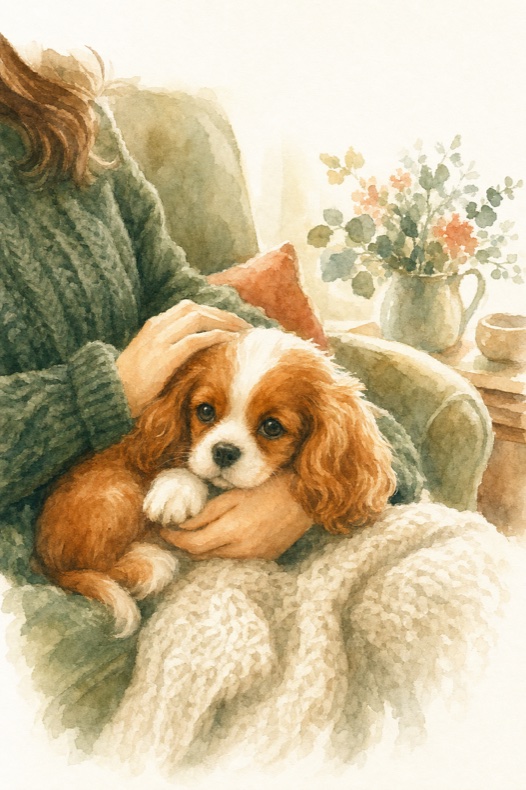
Mixed-breed context
The individual comes before the parent labels
- There is no single official breed standard for this mix.
- Traits are not an average of the parent breeds.
- Size, coat and temperament can vary widely with the individual and generation.
- Use both parent manuals as planning references, then train the dog in front of you.
Parent-breed manuals to compare
Use the puppy's observed response to people, novelty, food, problem-solving and carrying objects to choose rewards and management. A parent label predicts possibilities, not one fixed training profile.
What this means at home
Reality 01
A cross is not an average
Greater individual variation means the actual puppy sets the plan. Prepare suitable outlets and management for either parent side, then keep only what matches observed behaviour.
Reality 02
Alone time starts in the first week
This high-risk attachment combination needs planned, easy separations before constant companionship becomes the only way the puppy can settle.
Reality 03
The coat makes grooming a trained skill
Curly or wavy coat care and regular clipping require cooperative handling. Introduce each tool and sensation separately instead of waiting for a complete groom.
Reality 04
Carrying does not build ground confidence
Use carrying for real safety needs, then return to self-paced walking, distance and choice so the puppy learns how to move through the world on its own feet.
Breed reference data
| Reference | Value |
|---|---|
| Cross and Australian context | Cavalier King Charles Spaniel × Poodle; one of Australia's most common crossbreeds |
| Weight | 4–12 kg |
| Coat | Curly or wavy; requires regular clipping |
| Training rule | Observe the individual and prepare for drives from either parent side |
Suitability
Suited for
- Homes ready to begin gradual alone-time training in the first week
- People willing to train cooperative grooming as a lifelong skill
- Families prepared to adjust outlets, equipment and exercise to the actual individual
Not suited for
- Anyone expecting a predictable midpoint between two parent breeds
- Homes planning to postpone alone-time practice until a problem appears
- People who intend to carry the puppy past every uncertainty or force complete grooming sessions