

FluffyWA

Positive training · From eight weeks

Cavoodle Puppy Training Manual

From 8 Weeks

Cavoodle: a predictable bed cue supports calm settling and brief, gradual independence.

29 chapters · English / 中文

Watercolour illustration of a Cavoodle puppy resting calmly in a wicker basket bed with a soft blanket indoors
Cavoodle: a predictable bed cue supports calm settling and brief, gradual independence.

Breed profile

Training group
Toy and companion dogs
Origin
A Cavalier King Charles Spaniel × Poodle cross and one of Australia's most common crossbreeds.
Weight
4–12 kg
Coat
Curly or wavy coat requiring regular clipping
Coat care
Build cooperative acceptance of brushing, combing, coat parting, dryer and clipper sounds, and standing on a stable non-slip grooming surface.
Drive keywords
Living closely with people · Human connection · Problem-solving where expressed · Retrieving where expressed
Handling practice
Condition the brush, comb, coat parting, dryer and clipper sound separately on a stable non-slip surface; one easy voluntary step is training, while a forced full groom is not. · Practise calm paw and whole-body handling while the puppy remains supported on the ground, and teach a voluntary approach before lifting so carrying does not replace confidence work.

General reference range only; individual dogs vary considerably.

Teach safe mouth skills

Mouth-play boundaries and ground confidence

A small companion puppy still needs bite-force control, calm trades and clear mouth-play rules. Respond to the behaviour this individual shows, keep interactions at ground level where safe, and do not assume that either parent breed determines every use of the mouth.
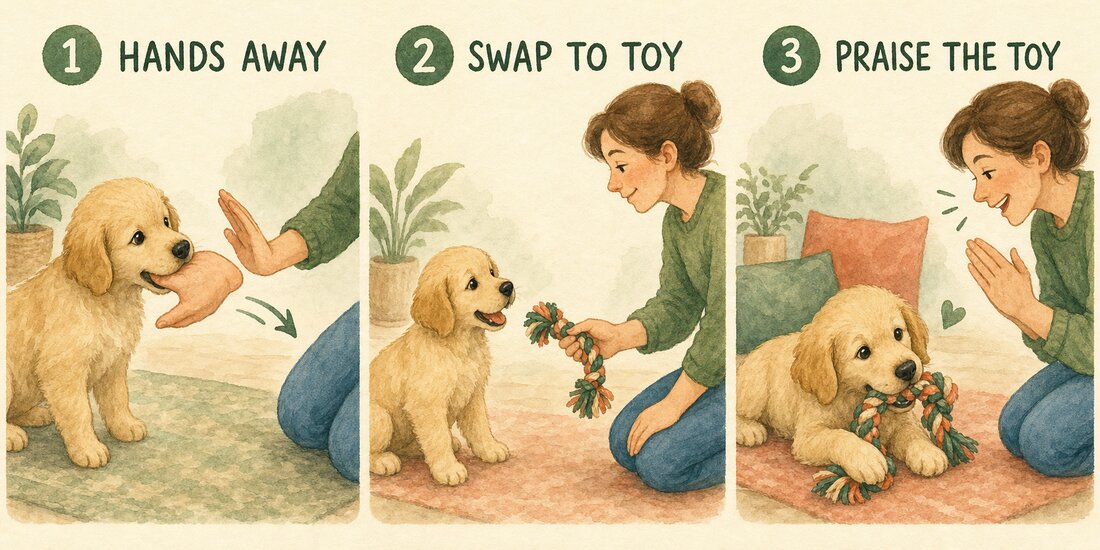
Watercolour three-step diagram showing hands moving away and puppy mouthing redirected to a toy
HANDS AWAY = make hands still and unavailable; SWAP TO TOY = offer an appropriate toy; PRAISE THE TOY = reinforce chewing the toy.

Identify the mouth-use pattern

Teach what is present instead of predicting it from the cross
PatternWhat it looks likeWhat it needs
Exploratory mouthingA loose puppy samples hands, clothing or reachable objects with the mouth.Teach bite-force control, manage access and redirect to a safe object.
Carrying or retrievingThe puppy picks up an object and may approach, move away or seek another repetition.If this pattern is present, provide a safe object and teach a calm trade-and-return routine.
Handling avoidanceThe puppy turns away, backs off or mouths when coat or body handling becomes too difficult.Stop, lower the handling step and restore voluntary participation rather than restraining harder.

A clear mouth-play and trade routine

  1. Offer a safe object Keep suitable toys available at ground level and begin the game on a consistent cue.
  2. Painful contact pauses interaction Pause calmly after painful contact and resume only when the puppy can return with a softer mouth; do not yell, grab or pin.
  3. Trade without creating pursuit Offer a worthwhile reward, mark release, secure the item and sometimes return a safe object so giving up does not always end access.
  4. End before arousal rises Finish on a cue while the puppy can still respond, then move to sniffing, settling or independent exploration.

Training with FluffyWA

Day school, board & train and private sessions are quoted after a chat, and boarding or daycare can be booked online with live prices.