

FluffyWA

Positive training · From eight weeks

Cavalier King Charles Spaniel Puppy Training Manual

From 8 Weeks

Cavalier King Charles Spaniel: reward calm settling and grow independence in small, kind steps.

29 chapters · English / 中文

Watercolour illustration of a Cavalier King Charles Spaniel puppy sitting calmly on a floor cushion beside a window
Cavalier King Charles Spaniel: reward calm settling and grow independence in small, kind steps.

Breed profile

Training group
Toy and companion dogs
Origin
Originated in England as a companion dog.
Shoulder height
30–33 cm
Weight
5–8 kg
Coat
Long, silky coat with long ears
Coat care
Build early, cooperative acceptance of routine coat and ear checks, brushing, gentle ear lifting, paw handling and standing on a stable non-slip surface.
Drive keywords
Living closely with people · Gentle social contact · Human attention
Handling practice
Condition routine long-ear checks as voluntary handling: brief ear touch, gentle lift or look, marker, reward and release before the puppy turns away. · Practise brushing and parting the silky coat in easy body areas on a stable non-slip surface, adding a new area only while the puppy remains loose and willing.

General reference range only; individual dogs vary considerably.

Teach safe mouth skills

Mouth-play boundaries for a gentle companion

A gentle small companion still needs bite-force control, calm trades and consistent mouth-play rules. Keep human movements small, work at ground level where safe, and distinguish normal puppy mouthing from a request to stop handling.
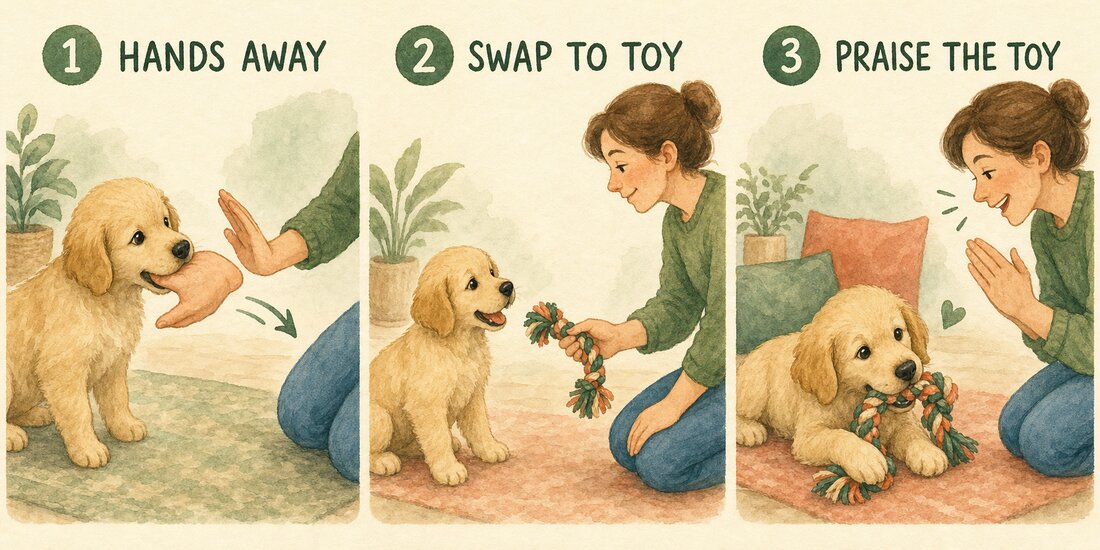
Watercolour three-step diagram showing hands moving away and puppy mouthing redirected to a toy
HANDS AWAY = make hands still and unavailable; SWAP TO TOY = offer an appropriate toy; PRAISE THE TOY = reinforce chewing the toy.

Identify the pattern before responding

Teach the mouth while protecting voluntary handling
PatternWhat it looks likeWhat it needs
Exploratory mouthingA loose puppy samples hands, clothing or safe objects with the mouth.Teach bite-force control and redirect to an appropriate object.
Over-aroused playMouthing becomes faster or harder, the body loses looseness and familiar cues stop working.End the game earlier and move to sniffing, settling or rest.
Handling avoidanceThe puppy turns away, freezes or mouths when an ear, coat or paw step becomes too difficult.Stop, lower the handling step and restore voluntary participation rather than holding harder.

A calm mouth-play routine

  1. Begin with a safe object Present a suitable toy after a consistent start cue and keep hands out of teasing play.
  2. Painful contact pauses interaction Pause calmly after painful contact and resume only when the puppy can return with a softer mouth; do not yell, grab or pin.
  3. Trade without pursuit Offer a worthwhile reward, mark release and secure the item; sometimes return a safe object so giving up does not always end access.
  4. Protect handling choice If mouthing begins during an ear, coat or paw step, stop and make the next repetition easier instead of treating it as disobedience.

Training with FluffyWA

Day school, board & train and private sessions are quoted after a chat, and boarding or daycare can be booked online with live prices.