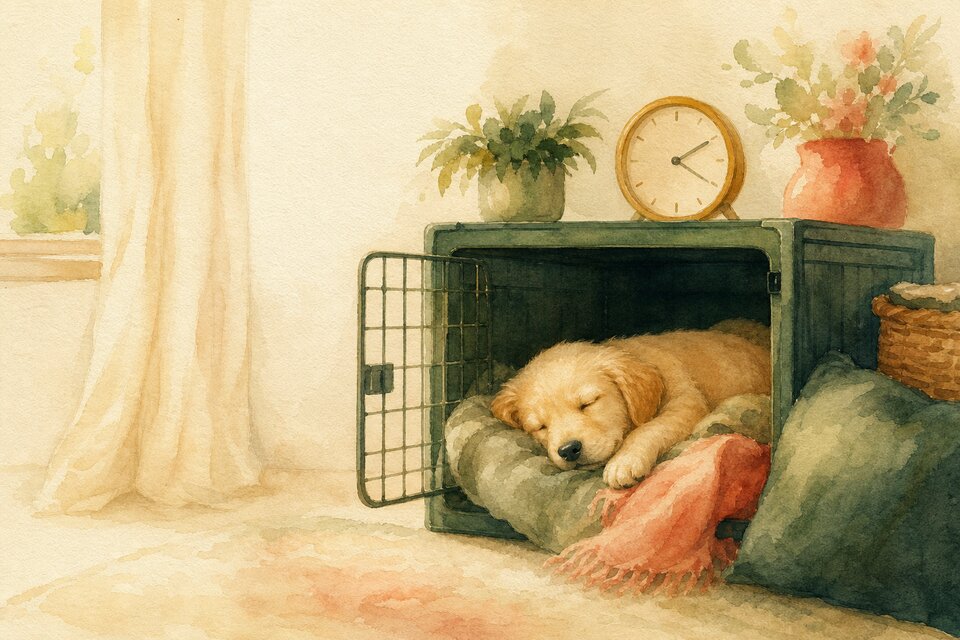
The crate is a bedroom, not a prison. It must never be used as punishment.
Eight-step crate desensitisation
Advance rule: move on only after the puppy has stayed relaxed through the previous step three times in succession.
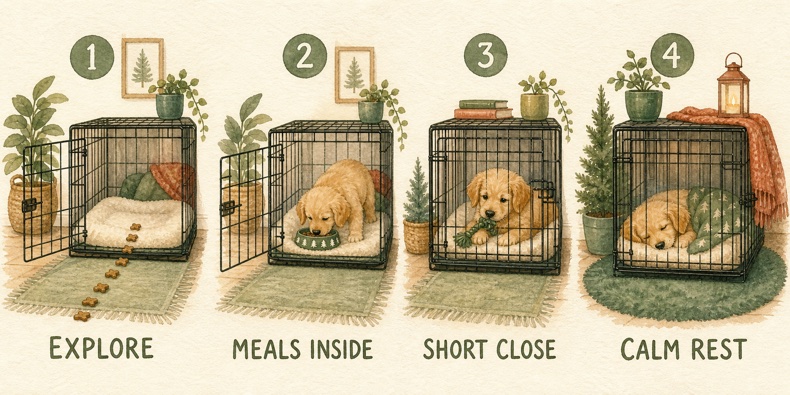
- Open door, free movement Toss food into the crate and allow the puppy to enter and leave freely. Do not close the door. Advance only after the puppy has remained relaxed through this exact step three consecutive times.
- Feed one complete meal inside Place the full meal inside and keep the door open throughout. Advance only after the puppy has remained relaxed through this exact step three consecutive times.
- Close for three seconds After the puppy enters, close the door for three seconds and open it again. Advance only after the puppy has remained relaxed through this exact step three consecutive times.
- Close for 10–30 seconds Stay beside the crate while the door is closed. Increase within this range only after the puppy has remained relaxed at the current duration three consecutive times.
- Filled toy, person in the room Give a filled toy behind the closed door while you sit elsewhere in the room. Advance only after the puppy has remained relaxed through this exact step three consecutive times.
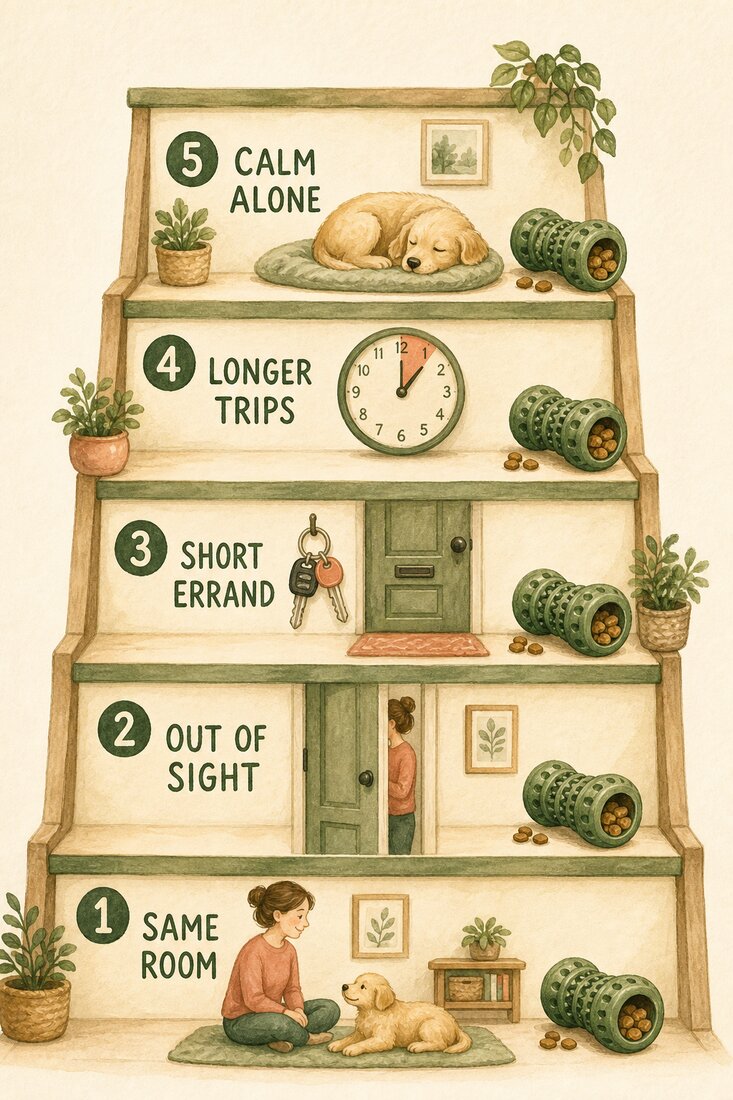
- Leave sight: 10 seconds → 1 minute → 5 minutes Close the door, step out of sight, and return before distress begins. Move to each longer duration only after three relaxed repetitions at the current duration.
- Crate naps twice daily Use the crate for two scheduled, protected naps each day. Advance only after the puppy has remained relaxed through this exact step three consecutive times.
- Leave home for 10 minutes and record Close the door, leave the home for 10 minutes, and use a phone recording to check whether the puppy remains relaxed. Extend beyond this duration only after three recordings show a relaxed puppy; do not lengthen a distressed repetition.
Read the recording, not your hopes
Success
The puppy sleeps
Settling and sleeping show the duration is currently manageable.
Go back one step
Persistent pacing, drooling, prolonged howling or attacking the latch
Reduce the difficulty and see Chapter 28. Separation anxiety cannot be improved by making the puppy “tough it out.”
Train alone time separately
Five seconds behind a baby gate
Step behind a baby gate for five seconds, then return. Keep everyday departures and arrivals uneventful: no farewell ritual and no excited greeting.
Desensitise departure signals
Keys do not always mean you are leaving
Puppies build predictions from repeated routines. Randomly pick up your keys, put on shoes or touch the door, then sit down again so those signals lose their certainty.