
FluffyWA

Positive training · From eight weeks

Australian Cattle Dog (Blue/Red Heeler) Puppy Training Manual

From 8 Weeks

Australian Cattle Dog: channel movement-control instincts into structured herding-ball play and calm thinking.

29 chapters · English / 中文

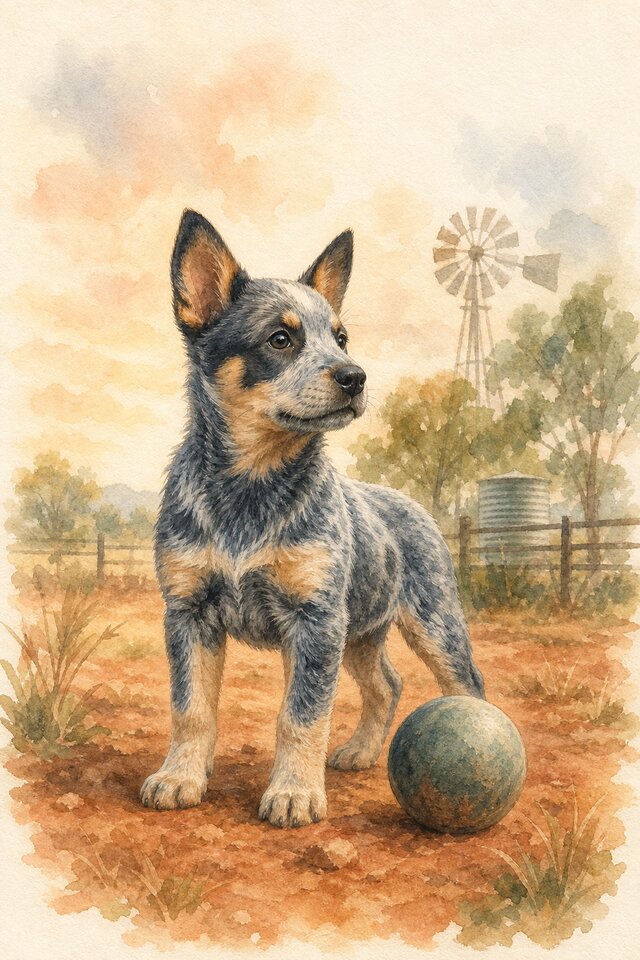
Watercolour illustration of an Australian Cattle Dog standing alert beside a herding ball in a dusty farm paddock with a fence, water tank and windmill
Australian Cattle Dog: channel movement-control instincts into structured herding-ball play and calm thinking.

Breed profile

Training group
Herding and cattle dogs
Origin
The Australian Cattle Dog originated in Australia as a cattle-droving working dog; its working sequence retains a strong grip used at cattle heels.
Shoulder height
43–51 cm
Weight
15–22 kg
Coat
Short double coat
Coat care
Build calm acceptance of brushing, coat checks, airflow and dryer noise, with voluntary paw and whole-body handling.
Drive keywords
Controlling movement · Endurance · Strong family attachment and guarding tendency
Handling practice
Condition short-double-coat brushing, coat checks, airflow and dryer noise in gradual, voluntary steps. · Practise calm paw, toe-space, ear and whole-body checks so routine care does not depend on one family member restraining the dog.

General reference ranges only; individual dogs vary considerably.

Start with the route you need

How to use this manual

This is an execution manual, not a book to read once and shelve.

Every practical chapter ends with “Do these three things,” so you always know what to do this week. Printable logs and scorecards are collected in Chapter 27.

Choose your reading path

Path 01

The puppy arrived today

Set up the environment and routine first, then move directly to toileting and crate work.

Path 02

The puppy has been home for two weeks

Build marker and focus skills, then address mouthing and safe socialisation.

Path 03

Is the Australian Cattle Dog (Blue/Red Heeler) right for your home?

Read the breed reality, the developmental clock and the long-term exercise limits before deciding.

How to read the cards

Warning card

Safety or behaviour risk

Stop, lower the difficulty and manage the situation before continuing.

Goal card

A clear passing standard

Use the stated behaviour and success rate to decide whether to progress.

Time card

Length of one session

End while the puppy is still successful; more minutes are not automatically better.

Training with FluffyWA

Day school, board & train and private sessions are quoted after a chat, and boarding or daycare can be booked online with live prices.