

FluffyWA

Positive training · From eight weeks

Siberian Husky Puppy Training Manual

From 8 Weeks

Siberian Husky: secure high fencing and managed outlets protect recall training from escape risk.

29 chapters · English / 中文

Watercolour illustration of a Siberian Husky puppy sitting in a garden enclosed by a tall wooden fence
Siberian Husky: secure high fencing and managed outlets protect recall training from escape risk.

Breed profile

Training group
Sled and spitz dogs
Origin
The Siberian Husky originated in Siberia as a sled dog.
Shoulder height
50–60 cm
Weight
16–27 kg
Coat
Thick double coat
Coat care
Build voluntary acceptance of brushing, coat separation, paw checks and dryer sound in gradual steps. The double coat must never be shaved as a cooling method.
Drive keywords
Running · Independent decision-making · Group howling
Handling practice
Introduce brushing, separating the dense coat and dryer sound from an easy distance, then progress only while the puppy remains willing to participate. · Generalise calm paw, ear, tail and whole-body checks across non-slip surfaces, different rooms and familiar handlers rather than assuming success in one station transfers automatically.

General reference range only; individual dogs vary considerably.

Teach safe mouth skills

Mouthing, pulling and voluntary release

Exploratory mouthing, forward pulling and handling avoidance need different responses. Teach bite-force control and release without turning the puppy's independent movement into a physical contest.
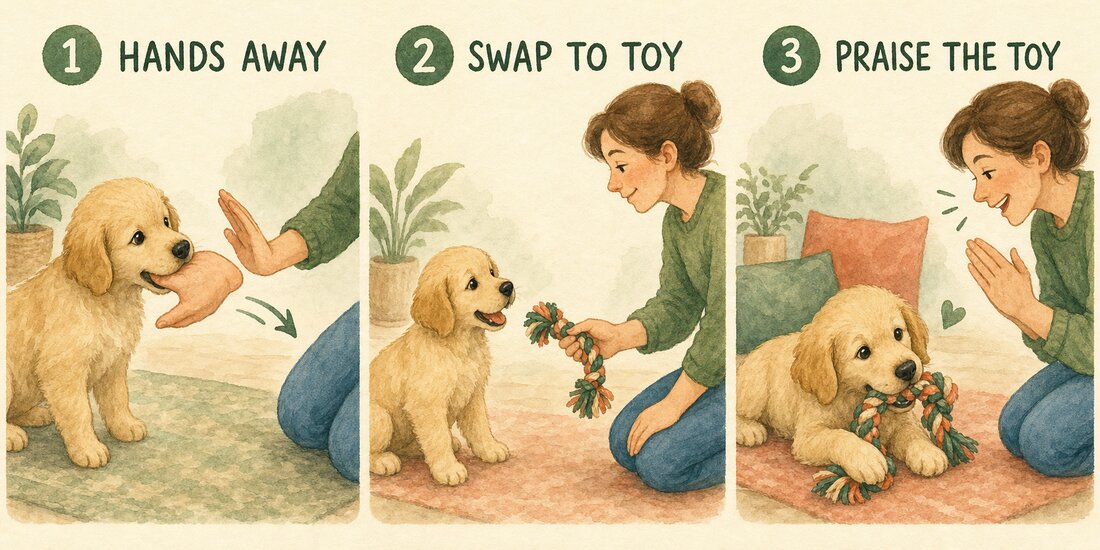
Watercolour three-step diagram showing hands moving away and puppy mouthing redirected to a toy
HANDS AWAY = make hands still and unavailable; SWAP TO TOY = offer an appropriate toy; PRAISE THE TOY = reinforce chewing the toy.

Identify the pattern before responding

Teach the mouth, manage forward motion and restore choice in handling
PatternWhat it looks likeWhat it needs
Exploratory or play mouthingA loose puppy puts teeth on hands, clothing or a nearby object during exploration or play.Teach bite-force control and redirect to a safe object.
Forward pullingThe body leans into the lead and forward travel becomes more valuable than the handler.Stop rehearsing tension, reward orientation and release forward only while the lead is loose.
Handling avoidanceThe puppy turns, mouths or leaves when brushing, paw checks or dryer sound becomes too difficult.Stop, lower the step and rebuild voluntary participation in that context.

Teach bite inhibition in three stages

8–12 weeks First: reduce force After a painful bite, stop interaction calmly for 3–5 seconds, then resume only when the puppy has settled.
12–16 weeks Then: reduce frequency Reinforce play that stays on safe toys and interrupt repeated contact with skin or clothing before arousal rises.
After 16 weeks Finally: keep teeth off people Keep mouth play on appropriate objects and preserve the same calm start-and-stop rules.

Do not skip force control by demanding zero mouthing immediately. Pulling on a lead and pulling in an adult sport are separate contexts; puppyhood is not the time for forced pulling work.

A clear mouth-and-movement routine

  1. Start with a safe object Present a safe toy on a cue and keep hands, sleeves and grooming tools outside the game.
  2. Release without a contest Offer a worthwhile trade, mark release and sometimes return the safe toy so letting go does not always end access.
  3. Use forward access as reinforcement Reward one check-in or loose-lead step, then release forward on a consistent cue while physical management stays attached.

Training with FluffyWA

Day school, board & train and private sessions are quoted after a chat, and boarding or daycare can be booked online with live prices.