FluffyWA

Positive training · From eight weeks

Labrador Retriever Puppy Training Manual

From 8 Weeks

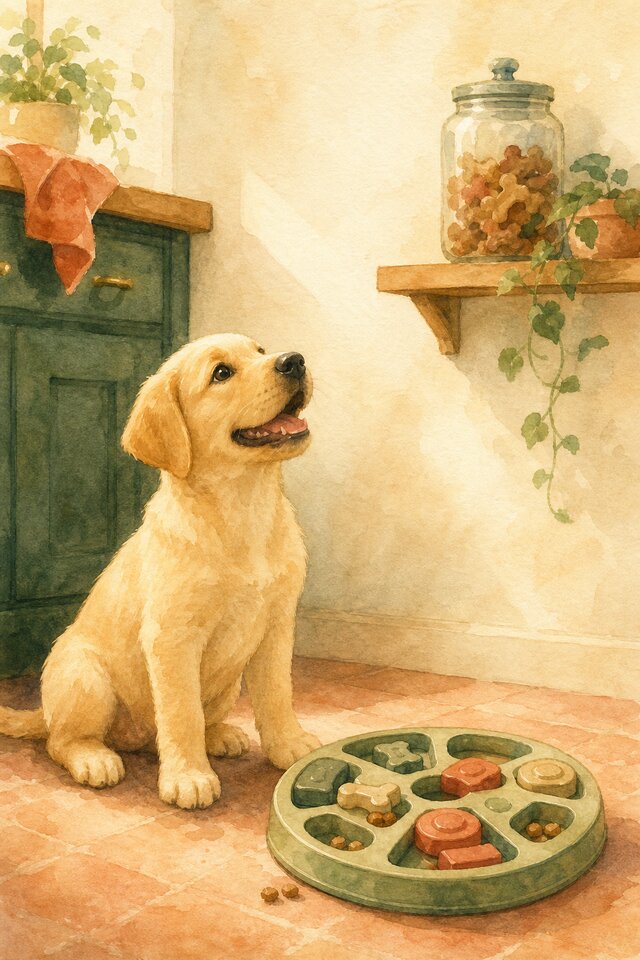
Labrador Retriever: food puzzles turn appetite into measured enrichment and impulse-control practice.

29 chapters · English / 中文

Watercolour illustration of a Labrador Retriever puppy sitting beside a round food-puzzle feeder with a jar of treats above
Labrador Retriever: food puzzles turn appetite into measured enrichment and impulse-control practice.

Breed profile

Training group
Gundogs and retrievers
Origin
The Labrador Retriever originated from Newfoundland fishing dogs and was developed for retrieving work.
Shoulder height
55–62 cm
Weight
25–36 kg
Coat
Short double coat
Coat care
Build calm, reward-based acceptance of brushing and of dryer or blower sound and airflow; do not force handling.
Drive keywords
Food · Retrieving · Social contact
Handling practice
Condition the short double coat to calm brushing and to dryer or blower sound and airflow, marking relaxed stillness and allowing breaks. · Build cooperative paw, nail and harness handling while the puppy is relaxed; stop before restraint creates a struggle.

General Australian reference range only; individual dogs vary.

Attention is the first cue

Name response & focus

Your puppy’s name has one meaning: “Look at me.” It does not mean “come,” it does not mean “stop,” and it must never become a reprimand.

The name game

  1. Say the name once Choose a random calm moment when the puppy is near you but looking elsewhere.
  2. Mark the turn The instant the puppy turns towards you, mark. Do not wait for a sit or a full approach.
  3. Reward and move on Deliver the reward, then return to normal life. Complete 20 repetitions each day, spread across the whole day.
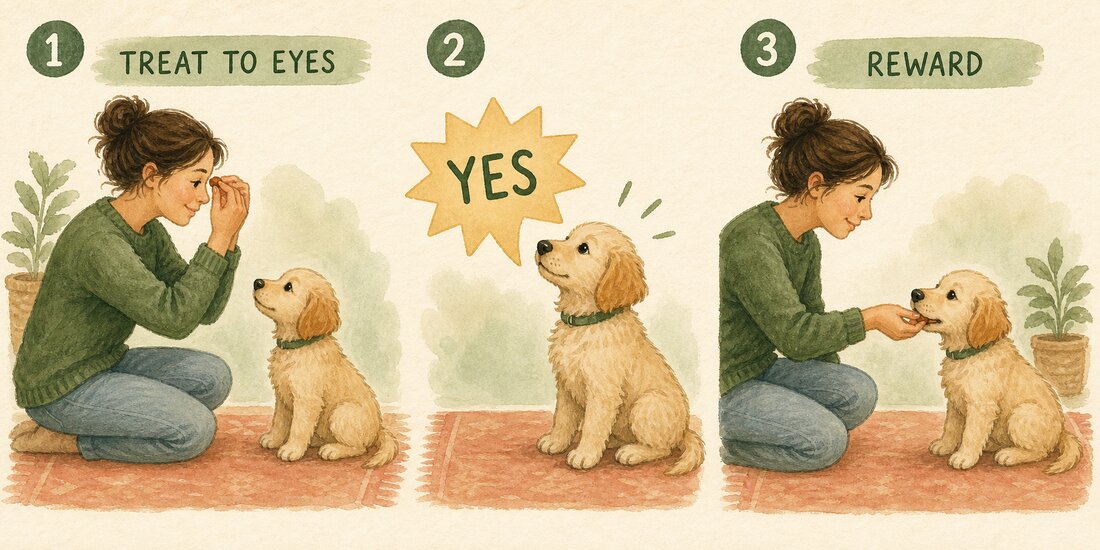
Watercolour three-step eye-contact exercise using a food lure, marker word and reward
TREAT TO EYES = bring the reward beside your eyes; YES = mark the instant the dog looks; REWARD = deliver the food promptly.

Build voluntary attention

Engage–Disengage

Reward the look you did not ask for

Voluntary attention is more valuable than attention that appears only after a cue. Mark whenever the puppy chooses to glance at you, then gradually practise around a view through the window, another dog or children.

Look at that

Looking is allowed; returning attention pays

Let the puppy look at the trigger. When it finishes looking and turns back, mark and reward. This foundation later helps the puppy disengage from movement, unfamiliar people and social excitement.

Training with FluffyWA

Day school, board & train and private sessions are quoted after a chat, and boarding or daycare can be booked online with live prices.