

FluffyWA

Positive training · From eight weeks

Labrador Retriever Puppy Training Manual

From 8 Weeks

Labrador Retriever: food puzzles turn appetite into measured enrichment and impulse-control practice.

29 chapters · English / 中文

Watercolour illustration of a Labrador Retriever puppy sitting beside a round food-puzzle feeder with a jar of treats above
Labrador Retriever: food puzzles turn appetite into measured enrichment and impulse-control practice.

Breed profile

Training group
Gundogs and retrievers
Origin
The Labrador Retriever originated from Newfoundland fishing dogs and was developed for retrieving work.
Shoulder height
55–62 cm
Weight
25–36 kg
Coat
Short double coat
Coat care
Build calm, reward-based acceptance of brushing and of dryer or blower sound and airflow; do not force handling.
Drive keywords
Food · Retrieving · Social contact
Handling practice
Condition the short double coat to calm brushing and to dryer or blower sound and airflow, marking relaxed stillness and allowing breaks. · Build cooperative paw, nail and harness handling while the puppy is relaxed; stop before restraint creates a struggle.

General Australian reference range only; individual dogs vary.

Teach safe mouth skills

Mouthing & retrieving

A Labrador's mouth can explore, carry, retrieve or swallow. Identify which pattern is happening, teach bite inhibition and calm release, and treat known or suspected foreign-object ingestion as an immediate veterinary matter.
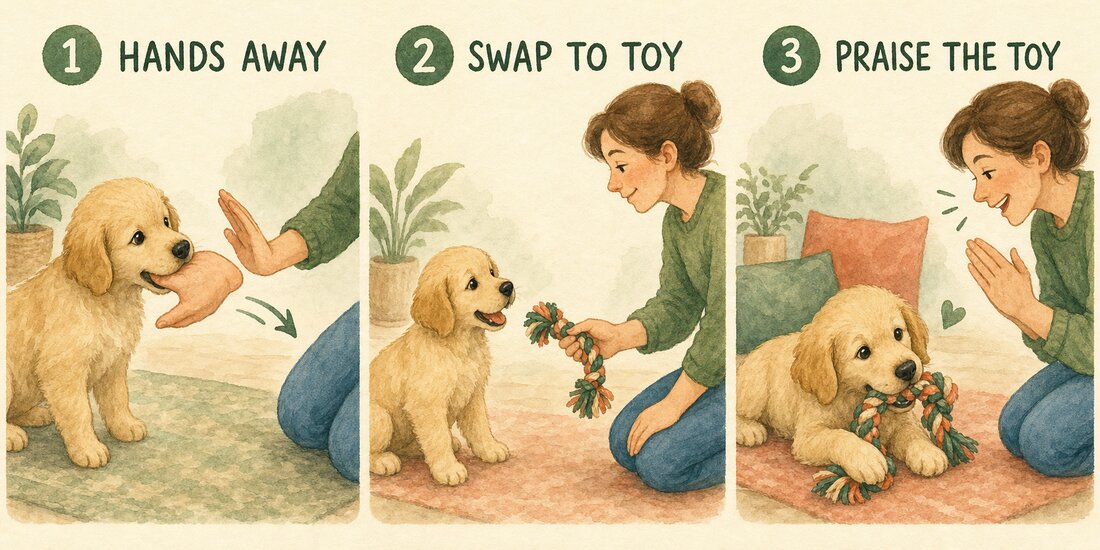
Watercolour three-step diagram showing hands moving away and puppy mouthing redirected to a toy
HANDS AWAY = make hands still and unavailable; SWAP TO TOY = offer an appropriate toy; PRAISE THE TOY = reinforce chewing the toy.

First identify what the mouth is doing

The correct response depends on whether the puppy is exploring, retrieving or creating an ingestion risk.
PatternWhat it looks likeWhat it means
Exploratory mouthingLoose sniffing, licking and mouthing of a safe object, with the body able to disengage.Normal exploration that needs safe choices and bite-inhibition rules.
Retrieving and carryingThe puppy picks up an object, carries it or moves toward a person with it.A gundog outlet to shape into delivery, Drop and safe return.
Ingestion riskThe puppy attempts to gulp a non-food object, or an object is missing after mouth contact.A safety event, not a training trial; known or suspected ingestion requires immediate veterinary contact.

Build a softer mouth and a reliable release

Foundation Painful contact pauses interaction After painful tooth contact, calmly pause interaction without hitting, yelling or holding the muzzle; resume only when the puppy is able to use a softer mouth.
Softer contact Put safe objects in the path before hands Offer a safe chew or retrieve object before arousal sends the mouth toward skin, and stop the activity while the puppy can still respond.
Reliable release Trade, mark and return safe items Use food to prompt a voluntary release, mark the mouth opening and return safe items often enough that Drop does not always predict permanent loss.

Bite inhibition means controlling force and disengaging safely. It does not mean punishing every normal use of the mouth.

Use this calm trade-and-return sequence

  1. Choose a safe practice object Practise only with an intact object that is appropriate for the puppy and cannot be swallowed.
  2. Offer the trade without grabbing Present higher-value food near the nose while keeping hands away from the object and the puppy's mouth.
  3. Mark the voluntary release The instant the mouth opens, mark, deliver the food and pick up the object only after the puppy has moved away from it.
  4. Return what is safe Return the safe object and continue briefly, so bringing an item to a person does not start a chase or always end access.

Training with FluffyWA

Day school, board & train and private sessions are quoted after a chat, and boarding or daycare can be booked online with live prices.