
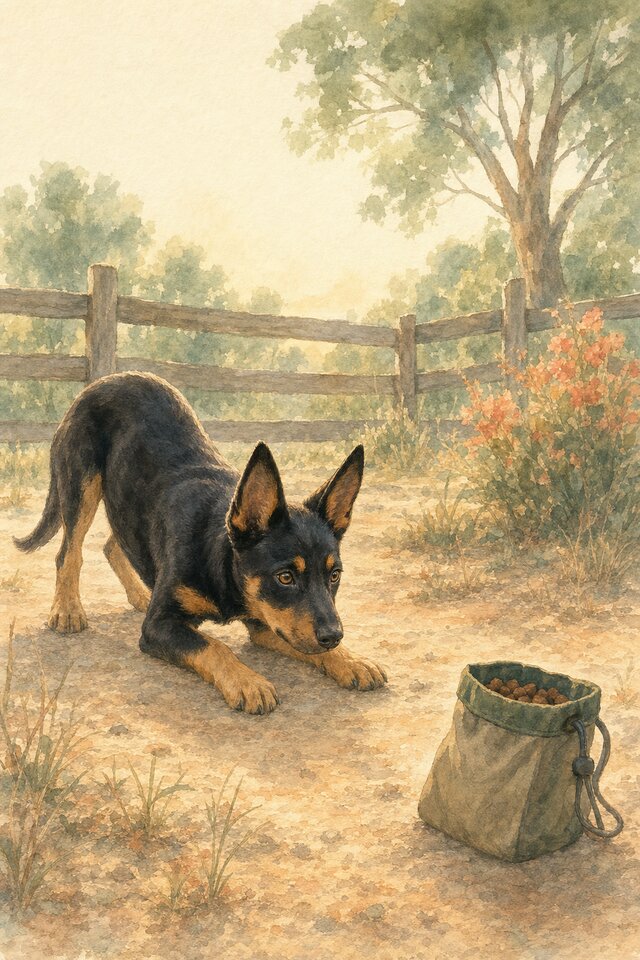
Sniffing and problem-solving create a different kind of effort from walking.
Give the Kelpie a job menu instead of endless mileage. Start a treibball foundation by sending to a floor target beside a large stable ball without impact; teach left and right directional targets; then shape picking up one safe household item and returning it to a marked basket. Keep each job brief, precise and followed by sniffing recovery.
Enrichment and outlet menu
| Type | Examples | Duration | Notes |
|---|---|---|---|
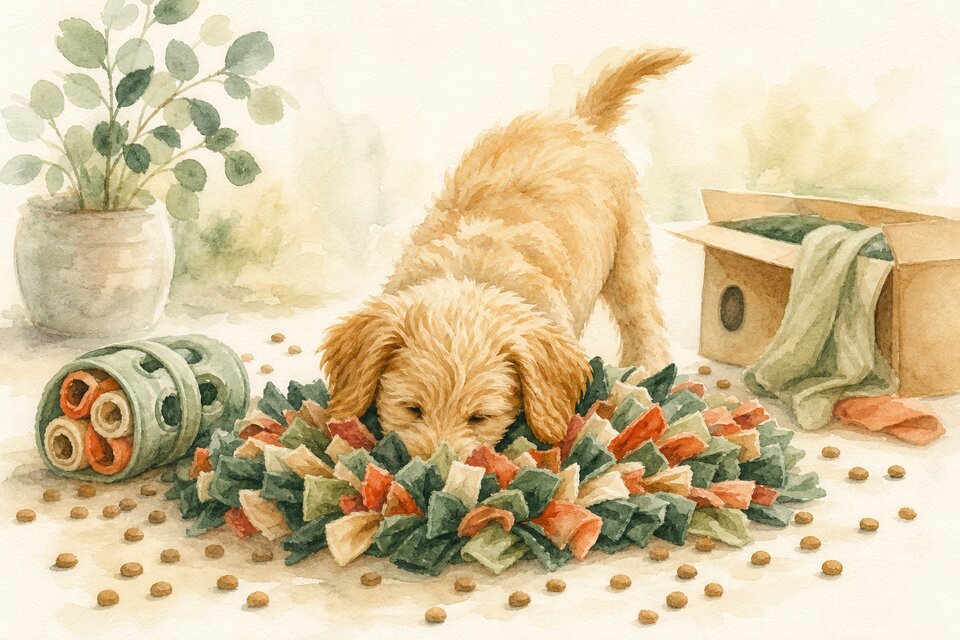
| Sniffing | Scatter feeding on grass, snuffle mat, food hidden in boxes, indoor treat search | About 5–15 minutes | Let the nose set the pace; easy searches should finish successfully. |
| Problem-solving | Treat ball, frozen stuffed toy, folded paper tube, food rolled in a towel | About 5–15 minutes | Begin easy enough to prevent frustration; frozen toys are especially useful during teething. |
| Shaping and tricks | Nose-to-hand touch, spin, weave through legs, toys into a box, switch a light on or off | Up to 10 minutes per session, with breaks | Use shaping and split the skill into tiny, winnable steps. |
| Purposeful job menu | Treibball target, directions, tidy-away retrieve | Two to five precise minutes | Avoid impact and finish with sniffing recovery. |
| Rule-governed flirt pole | Cue a wait, sweep the toy low for a brief chase, then trade on “drop.” | Two rounds of 3–5 seconds of chasing. | Keep turns wide and low-impact; follow with sniffing and limit to one session daily. |
| Rule-governed tug | Start on cue, tug in a straight low line, pause, then trade on “drop.” | Three 10-second turns with calm pauses. | Stop if teeth contact skin or the dog cannot release; finish with a scatter search. |
| Scent searching | Scatter food in grass, search open boxes or find a hidden familiar toy. | 5–10 minutes after movement-based play. | Keep the search easy enough to lower arousal; use measured food from the daily allowance. |
| Directional cue games | Send left or right around a barrel, then return to a mat or hand target. | Four to six slow repetitions on each side. | Use walking pace, a non-slip surface and wide turns; no rapid weaving or jumping. |
| Adult herding-ball work | Move a large stable ball between two targets under qualified instruction. | A short coached block with rest between turns. | For physically mature dogs only; avoid repetitive collision, sharp turns and uncontrolled chasing. |
| Chewing | Veterinarian-approved chew, a small amount of frozen carrot | Puppy-led and supervised | Ask your veterinarian which chews suit your puppy; remove damaged pieces. |
One-week enrichment rotation
| Day | Main block | Recovery block |
|---|---|---|
| Mon / Thu | Easy sniffing search, then one group outlet at the dog's current stage. | Quiet chew and protected sleep. |
| Tue / Fri | Food puzzle plus two minutes of shaping or cooperative handling. | Scatter feed or slow sniffing. |
| Wed / Sat | Signature protocol at easy criteria; stop while cues still work. | Mat settling and uninterrupted rest. |
| Sun | Recovery audit: repeat only an easy favourite if the dog is ready. | Plan the next week from recovery, not exhaustion. |
Teething
Prepare cold outlets before four to six months
Chewing demand rises sharply at about 4–6 months. Prepare frozen stuffed toys in advance; increased chewing at this age is a developmental need, not a training regression.
Independent ability
Let the dog solve ten minutes alone
Offer a safe puzzle or chew and let the dog work independently for ten minutes. Without opportunities to practise independent settling, some dogs may find alone time harder.