

FluffyWA

Positive training · From eight weeks

Jack Russell Terrier Puppy Training Manual

From 8 Weeks

Jack Russell Terrier: a legal digging area channels terrier persistence into an allowed outlet.

29 chapters · English / 中文

Watercolour illustration of a Jack Russell Terrier puppy enthusiastically digging in a bordered garden sandpit
Jack Russell Terrier: a legal digging area channels terrier persistence into an allowed outlet.

Breed profile

Training group
Terriers
Origin
The Jack Russell Terrier originated in England as an earth-working terrier used to pursue quarry underground.
Height at shoulder
25–30 cm
Common weight range
6–8 kg
Coat
Short or rough coat
Coat
Short or rough coat
Coat care
Condition calm acceptance of brushing, body checks and paw handling, using tools suited to the individual coat.
Drive keywords
Small-animal hunting · Digging · Chasing
Handling practice
Calm, gradual brushing and coat checks for the individual short or rough coat. · Voluntary paw, toe-space, ear and whole-body checks after digging or outdoor activity.

General reference ranges only; individual dogs vary substantially

Teach safe mouth skills

Tearing, mouthing & hunting instinct

Exploratory mouthing, play tearing and predatory pursuit are not the same behaviour. Teach bite inhibition and toy rules, while preventing the puppy from ever practising the hunting sequence on wildlife, cats or other live animals.
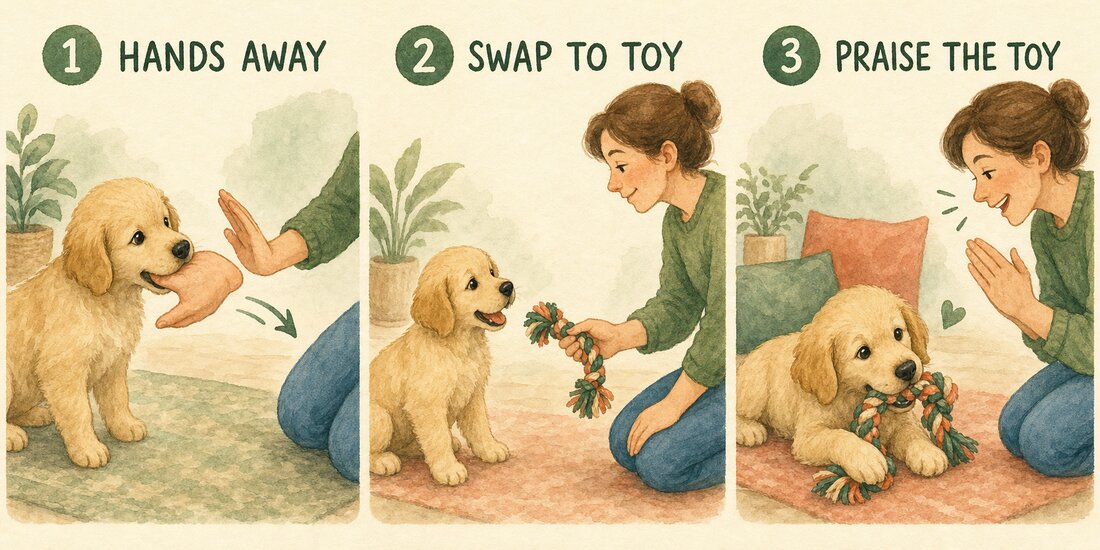
Watercolour three-step diagram showing hands moving away and puppy mouthing redirected to a toy
HANDS AWAY = make hands still and unavailable; SWAP TO TOY = offer an appropriate toy; PRAISE THE TOY = reinforce chewing the toy.

Identify the mouth behaviour before responding

The movement pattern tells you whether to teach, redirect or create immediate distance
TypeWhat it looks likeWhat it means
Exploratory mouthingThe puppy samples hands, clothing and household objects with a loose body.Normal exploration needs supervision, safe objects and bite-inhibition teaching.
Rule-based tearing or shaking playThe puppy grips a designated toy, pulls or shakes, then can trade and return to the person.This can be a legal outlet when start, Drop and finish rules remain clear.
Predatory pursuitThe body fixes on a small animal, movement becomes direct and intense, and familiar food or cues may lose value.Create distance and use physical management; do not treat a live target as a training prop.

Teach bite inhibition in three stages

8–12 weeks First: do not bite hard For a hard bite, say one brief “Ouch” and stop interaction for 3–5 seconds. Offer an appropriate toy only when the puppy can re-engage calmly.
12–16 weeks Then: use the mouth less often Reinforce play that stays on designated toys and interrupt repeated contact with skin or clothing before arousal rises.
After 16 weeks Finally: no mouth on people Keep tearing and shaking on designated toys; human skin and clothing no longer continue the game.

Do not skip force control by demanding no mouthing immediately. Teach a softer mouth first, then reduce frequency, while keeping live-animal pursuit completely unavailable.

A four-part outlet and safety plan

  1. Manage live targets first Scan the yard, use secure barriers and keep the puppy on a lead or long line where wildlife may appear. Training does not replace prevention.
  2. Put cues around the toy Invite the grip on a cue, keep teeth away from hands, trade on Drop and either return the toy or end clearly while the puppy remains responsive.
  3. Complete the job legally Use ground-level food searches, supervised tearable cardboard and the designated digging area so searching, tearing and digging have safe, legal outlets.
  4. Reward the turn away At a manageable distance from low-intensity movement, mark the first head turn back to you and pay well. If the puppy cannot eat or respond, increase distance instead of repeating the cue.

Training with FluffyWA

Day school, board & train and private sessions are quoted after a chat, and boarding or daycare can be booked online with live prices.